
Lighting Mistakes That Hide Your Austin Home's Best Features
Your Austin home has features worth showing off after dark. Hill Country limestone with that warm honey texture. A roofline stretching wide across the lot. Stone columns flanking the entry, cedar beams under the porch, maybe a covered patio that doubles as outdoor living space half the year. These are the things that give a Central Texas home its character.
But across West Lake Hills, Lakeway, Barton Creek, Circle C, and the greater Austin metro, we see homes where the lighting is actually working against the house. Not because the homeowner skipped lighting, but because the approach is hiding the very features that make the home beautiful. A gorgeous limestone facade flattened into a bright white wall. A roofline that disappears into the night sky. Hardware that looks worse than no lights at all.
These are fixable problems, every one. Here are eight of the most common lighting mistakes we see on Austin homes and what actually works instead.
Mistake 1: The Parking Lot Effect
This is the most common mistake on our list, and it comes from a perfectly reasonable instinct. You want your home visible at night, so you install floodlights aimed at the front of the house. More light, more curb appeal, right?
On Hill Country limestone, the opposite is true. Floodlights produce an intense, even wash that hits every surface at the same intensity from the same angle. All the character that makes Austin stone special, the depth between mortar joints, the chisel marks, the way some stones jut forward while others sit slightly recessed, vanishes under uniform light. The shadows that create visual depth get erased, and what's left is a bright, flat surface that could be painted drywall.
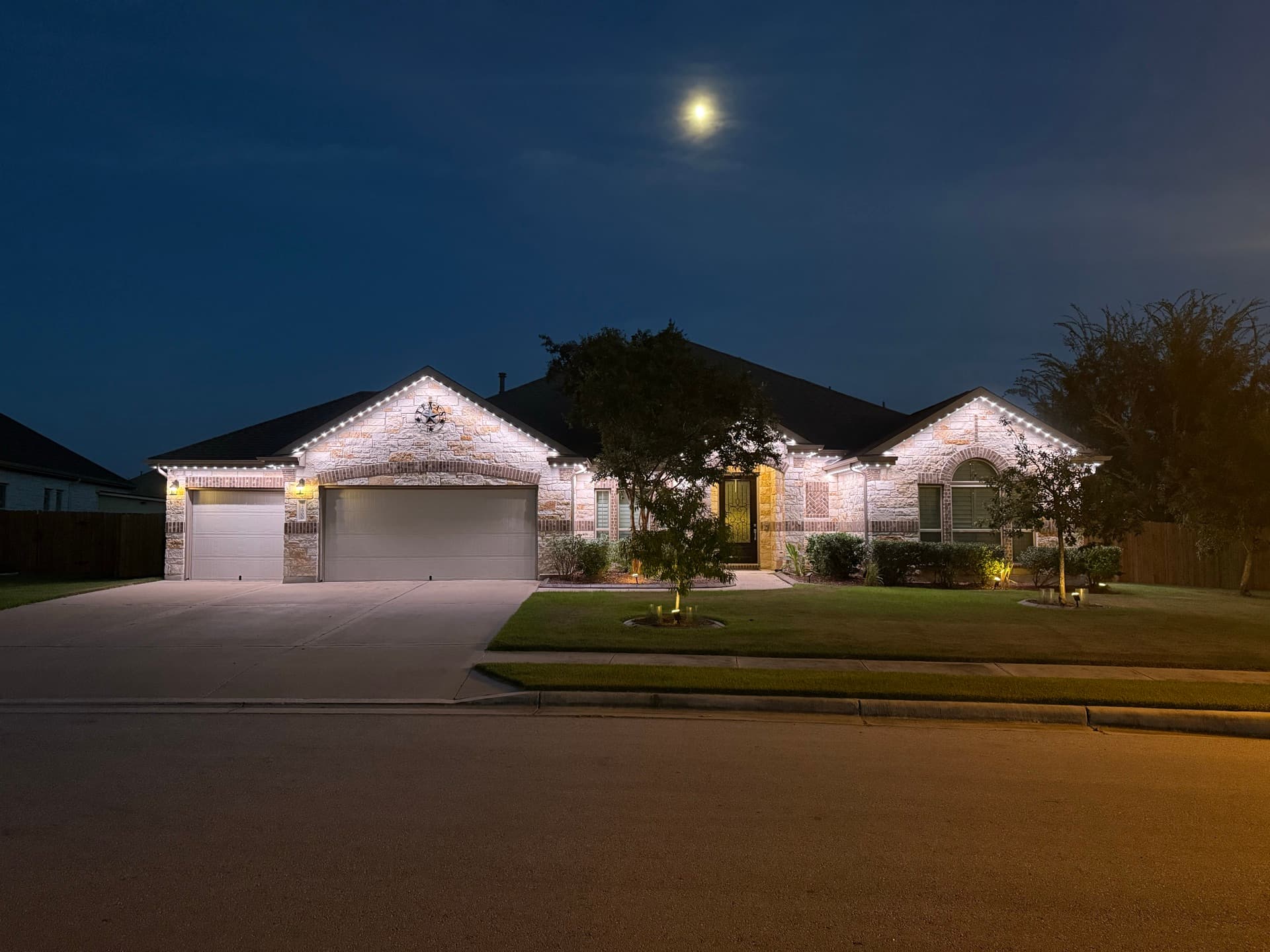
The fix is about direction, not intensity. Roofline-mounted LEDs that wash downward along the facade create natural highlights on the raised portions of each stone face while the recessed areas fall into soft shadow. That interplay is what gives limestone its nighttime drama. When you see a home in Dripping Springs or Georgetown that seems to glow after dark, it's because the light is working with the stone's texture instead of overpowering it.
Mistake 2: Wrong Color Temperature on Warm Stone
Homeowners often know something looks "off" about their house at night but can't pinpoint what. The stone looks gray even though it's warm cream during the day. Nine times out of ten, the culprit is color temperature.
Color temperature is measured in Kelvin (K). Lower numbers (2700K) produce warm, golden light. Higher numbers (5000K+) produce cool, bluish white. Most budget LED floodlights from big-box stores default to 4000K or higher because cool white looks impressively bright on the shelf.
Put that cool white on Hill Country limestone and the stone dies. The golden undertones shift to gray. The cream turns ashy. It's like putting a blue filter over a golden hour photo. There's plenty of light, but every bit of warmth has been stripped out.
Austin stone looks its best under warm white in the 2700K to 3000K range. The light reinforces the natural color in the stone rather than fighting it. Creams stay creamy. Honey tones deepen slightly. This holds true for limestone, ledger stone, natural tan masonry, and the warm-toned stucco finishes on newer builds in Cedar Park and Dripping Springs. If your house feels cold at night, check your color temperature before anything else.
Mistake 3: Ignoring the Roofline
Here's a pattern we see constantly in Lakeway and Barton Creek: a homeowner invests in landscape lighting. Uplights in the flower beds, path lights along the walk, a couple of spots on the front door. The ground level looks great. But from about six feet up, the house vanishes into darkness.
The roofline is the biggest architectural feature on most Austin homes. On a Hill Country ranch, it's that long, low horizontal line that gives the home its grounded presence. On a two-story in West Lake Hills, it's the gable peaks and varied elevations. On a modern build in Circle C, it's the sharp, clean edges. When the ground is lit but the roofline is dark, you're showing visitors the lawn and hiding the architecture.
Permanent roofline lighting reverses this. Lights mounted along the fascia and architectural edges define the home's shape from the top down. The roofline becomes visible, gable peaks get definition, and the facade receives a warm downward wash that reveals the stone and stucco below. Now your landscape lighting works as a complement to the architecture rather than a substitute for it.
Mistake 4: One-Zone Thinking
Most basic setups treat the entire house as a single circuit. Every light at the same brightness, the same color, on the same schedule. The house is lit, but so much potential is left sitting there.
A typical Austin home has a main roofline, a garage section, a front entry with stone detailing, a covered patio, maybe a gable peak. Each section features different materials, different textures, different architectural roles. Lighting them all identically is like painting every room the same color. It works, technically. But it ignores the fact that different features call for different treatment.
Zone-based control lets the entry get a touch more intensity to draw the eye while the garage dims so it doesn't compete. The gable peak runs at a moderate level. The patio drops to a warm glow for evenings outside. TruLight's app control makes this practical because you can adjust each zone independently from your phone. Set up a few scenes and switch between them without touching a fixture. A house lit as one flat zone looks like it has lights. A house with intentional zones looks like it was designed.
Mistake 5: The Holiday-Only Mentality
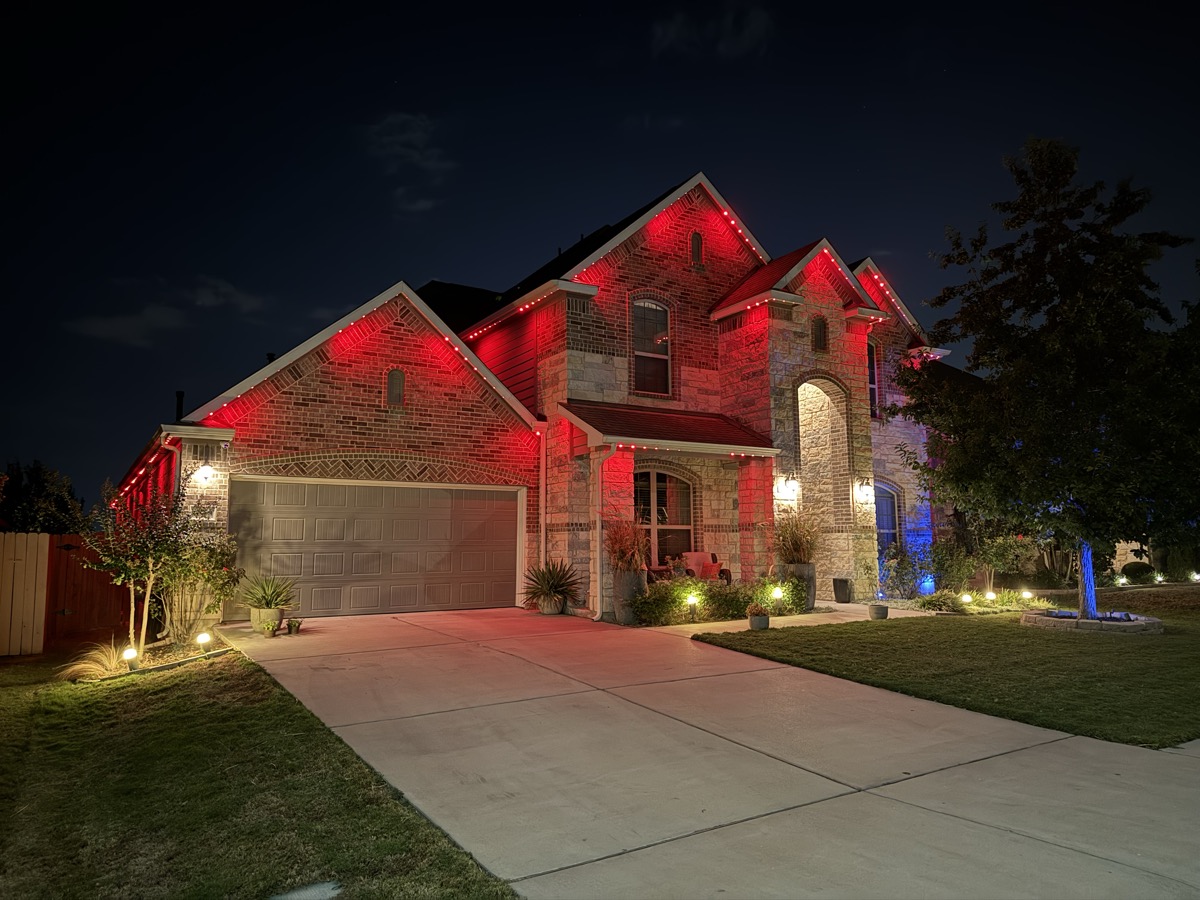
December arrives. You hire a crew or climb a ladder yourself to hang holiday lights along the roofline. They look fantastic for six weeks. Then they come down, and for the other ten and a half months, your roofline sits dark.
Between annual installation costs, replacing strands that degraded in the Texas heat, and the time spent coordinating schedules, most Austin homeowners spend $800 to $2,000 a year for six weeks of seasonal lighting and zero roofline presence the rest of the time.
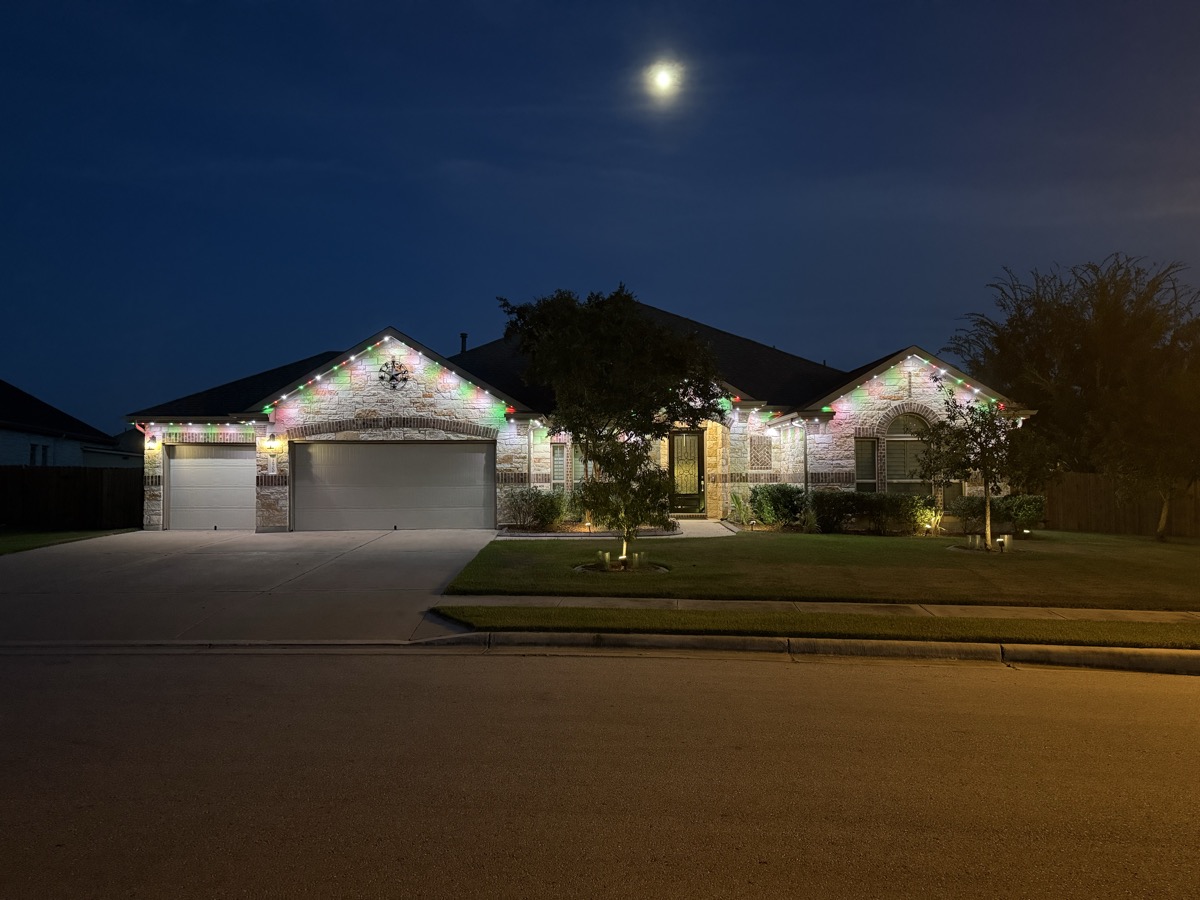
A permanent system changes the equation. Yes, you get Christmas lights. But you also get every other night of the year. Warm white for everyday curb appeal. Burnt orange for UT game days (your West Lake Hills neighbors will appreciate that one). Red, white, and blue for the Fourth. Pink for a birthday party. A slow color cycle for a backyard gathering. The system is always there, always ready, and never requires a ladder. Your home has a nighttime presence 365 nights a year instead of 42.
Mistake 6: Cheap RGB "White" on Austin Stone
This mistake is hardest to spot in product photos and easiest to see in real life. Many permanent lighting companies install RGB systems, meaning their LEDs produce color by mixing red, green, and blue diodes. When you set an RGB system to "white," all three colors fire at full intensity. In theory, that creates white light. In practice, it almost never looks right on Austin homes.
Wondering what it would cost for your home? Get an instant estimate using our satellite tool. No visit required.
Get Your Free QuoteRGB-mixed white has a persistent tendency to skew blue or purple. It's a physics issue, not a brand issue. The individual diodes are calibrated for vivid color output, and when they mix to approximate white, the result is a cool, slightly bluish "white" that lands in the 5000K to 6500K range. On warm limestone, that blue tint does everything wrong. Cream stone goes gray. Honey surfaces look washed out. The whole facade takes on an almost clinical quality that fights the natural warmth of Hill Country materials.
It gets worse with age. As individual RGB diodes degrade at slightly different rates over time, one section of your roofline starts looking pinker than the rest. Another develops a green tint. The "white" you started with drifts into something inconsistent and cheap-looking. On a $600,000 to $2 million home, that's not the impression anyone wants.
This is the core reason TruLight installs RGBW systems with 6 LEDs per node: 3 RGB LEDs for full color capability plus 3 dedicated warm white LEDs. When you want white, the dedicated warm white diodes handle it. Real 2700K to 3000K white from purpose-built diodes, not an approximation from mixing colors. And when you want true pure white, all 6 LEDs fire together, blending warm white and RGB cool white to produce a clean, bright white that no RGB-only system can match. The warm white stays consistent for the full 100,000-hour lifespan. You still get every color in the spectrum from the RGB diodes, but your everyday white is coming from the right source.
If you've driven past a neighbor's home and thought their "white" permanent lights looked a bit cold or bluish on the limestone, that's almost certainly an RGB-only system. The difference between that and dedicated warm white is dramatic, and it's the difference homeowners in Barton Creek and Georgetown notice immediately when they see both side by side.
Mistake 7: Visible Hardware That Hurts Daytime Curb Appeal
Outdoor lighting should make your home look better after dark. At a minimum, it shouldn't make it look worse during the day. But bulky track systems along the fascia, exposed wires between mounting points, oversized fixture housings, clip-on puck lights with visible cords dangling below the soffit... during the fourteen hours of daylight Austin gives you in June, they sit there looking like exactly what they are: hardware bolted onto the outside of your house.
For homeowners who've invested in architecture, finishes, and landscaping, visible lighting hardware works against every other curb appeal decision you've made. The stone looks great. The landscaping is perfect. And then there's a plastic track with wiring running across the fascia board.
TruLight's system is designed to be functionally invisible during the day. The fixtures sit in the fascia channel and mount flush against the roofline. No exposed tracks, no visible wires, no bulky housings. The lighting only becomes apparent after dark. This matters especially in neighborhoods with active HOAs like Circle C and Barton Creek, where architectural review committees pay close attention to exterior modifications. Nothing to see during the day means no issues with approval.
Mistake 8: Light Trespass in Close-Lot Neighborhoods
Austin is growing fast, and lot sizes in many newer developments are getting tighter. In neighborhoods across Cedar Park, Georgetown, Mueller, and parts of Circle C, homes sit close enough that exterior lighting becomes a shared experience whether you planned for it or not. Light trespass, light that spills beyond your property into a neighbor's windows or yard, is the outdoor lighting version of playing music too loud.
Floodlights are the worst offenders. Their wide, unfocused beams spray light in every direction, and on a smaller lot, a meaningful amount lands on the neighbor's property. Landscape uplights aimed wrong can throw light directly into second-story windows across the fence.
Roofline-mounted, downward-facing LEDs are inherently better for light control. The light travels down along your own walls, illuminating your facade without projecting outward. The architecture of the house itself contains the light. TruLight's zone control adds another layer: zones facing a close neighbor can run at lower brightness than street-facing zones. The result is a home that looks beautifully lit from the curb while being respectful where proximity matters.
The Common Thread: Design Over Hardware
Every one of these eight mistakes comes from the same root cause: treating outdoor lighting as a hardware problem instead of a design problem. The real question isn't "how many lights do I need?" It's "what do I want the light to accomplish for my specific home, my specific materials, and my specific neighborhood?"
Hill Country limestone wants warm light at the right angle. Your roofline wants definition after dark. Your neighbors want you to keep your light on your property. Your HOA wants invisible hardware. And you want a system that handles holidays, everyday curb appeal, game days, and entertaining without climbing a ladder every time. All of that points in one direction: a permanent RGBW system custom-designed for your home, mounted invisibly along the roofline, and controllable zone by zone from an app. TruLight's 48-volt architecture, 6 LEDs per node (3 RGB + 3 dedicated warm white), 100,000-hour lifespan, integrated motion sensors, and lifetime warranty handle the performance side. The design is what makes it personal to your home.
Frequently Asked Questions
How can I tell if my current lighting is making one of these mistakes?
Drive past your home after dark and look at it the way a visitor would. Does the stone look warm and textured, or flat and gray? Can you see the roofline shape, or does the upper half disappear? If something looks off, one or more of these mistakes is likely the cause.
Can these mistakes be fixed without replacing everything?
If the issue is color temperature or brightness, a system with app control can sometimes be adjusted. If the problem is fixture placement, visible hardware, or no zone control, those are hardware limitations that typically require a system upgrade. A permanent RGBW system addresses all eight issues at once.
What about mixed-material homes?
Stone and stucco reflect light differently, so mixed-material homes benefit the most from zone control. Each section gets the brightness it needs, and the overall look stays cohesive. This is one of the most common setups we install in Lakeway and West Lake Hills, where two-story homes frequently combine limestone and stucco.
Will permanent lighting add much to my energy bill?
Not meaningfully. TruLight's 48-volt LED system is highly efficient. Most whole-home installations consume less energy than a single traditional light bulb left on overnight.
Does TruLight Austin handle HOA approvals?
Yes. We handle the approval process as part of every installation in communities that require it. We're familiar with the requirements in Circle C, Barton Creek, Lakeway, and other Central Texas neighborhoods with active committees.
See What Your Home Looks Like Without These Mistakes
Every home is different, and the right lighting design depends on your specific materials, architecture, lot size, and neighborhood context. TruLight Austin works with homeowners across Central Texas, from West Lake Hills and Lakeway to Dripping Springs, Georgetown, Cedar Park, and everywhere in between.
Request a free, no-obligation quote and we'll show you exactly how a custom permanent lighting design would work on your home. We'll walk through your architecture, your materials, and your goals, and put together a plan that avoids every mistake on this list. No pressure, just a conversation about what your home could look like after dark.
Ready to Light Up Your Home?
Use our light preview tool to see your home in warm white, holiday colors, and more. Then get your free instant quote.
Get Your Free Quote Instantly