
Designing Architectural Lighting for Stone and Stucco Homes in Austin
If you've ever driven through West Lake Hills or Barton Creek after dark, you've seen it: one house that glows like it was designed for nighttime, and three next to it that basically vanish. The difference isn't the size of the home or the price of the landscaping. It's how the light interacts with the materials on the exterior.
Austin is a stone and stucco city. Hill Country limestone, cream-colored stucco, rough-cut Texas ledger stone, cedar accents, natural tan masonry. These materials have warmth, texture, and depth built right in. But they only show that character under the right kind of light. Get the lighting wrong, and a $1.5 million limestone home looks like a warehouse. Get it right, and the stone practically radiates at night.
This is the thing most homeowners in Lakeway, Circle C, Dripping Springs, Georgetown, and Cedar Park don't realize until they see a well-lit home next to one without: architectural lighting isn't about brightness. It's about drawing out what's already there in the stone and stucco that make Central Texas homes so distinctive.
Why Hill Country Limestone Demands Warm White Light
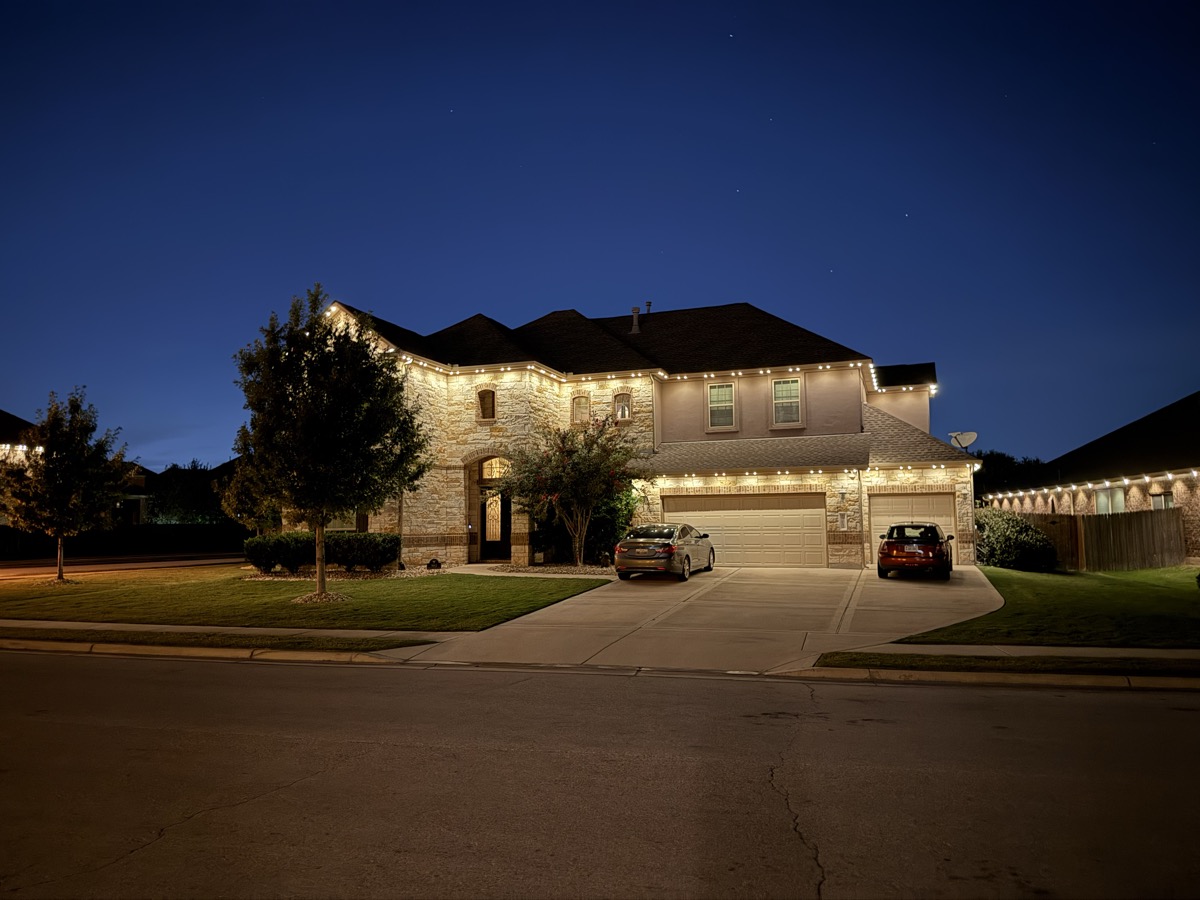
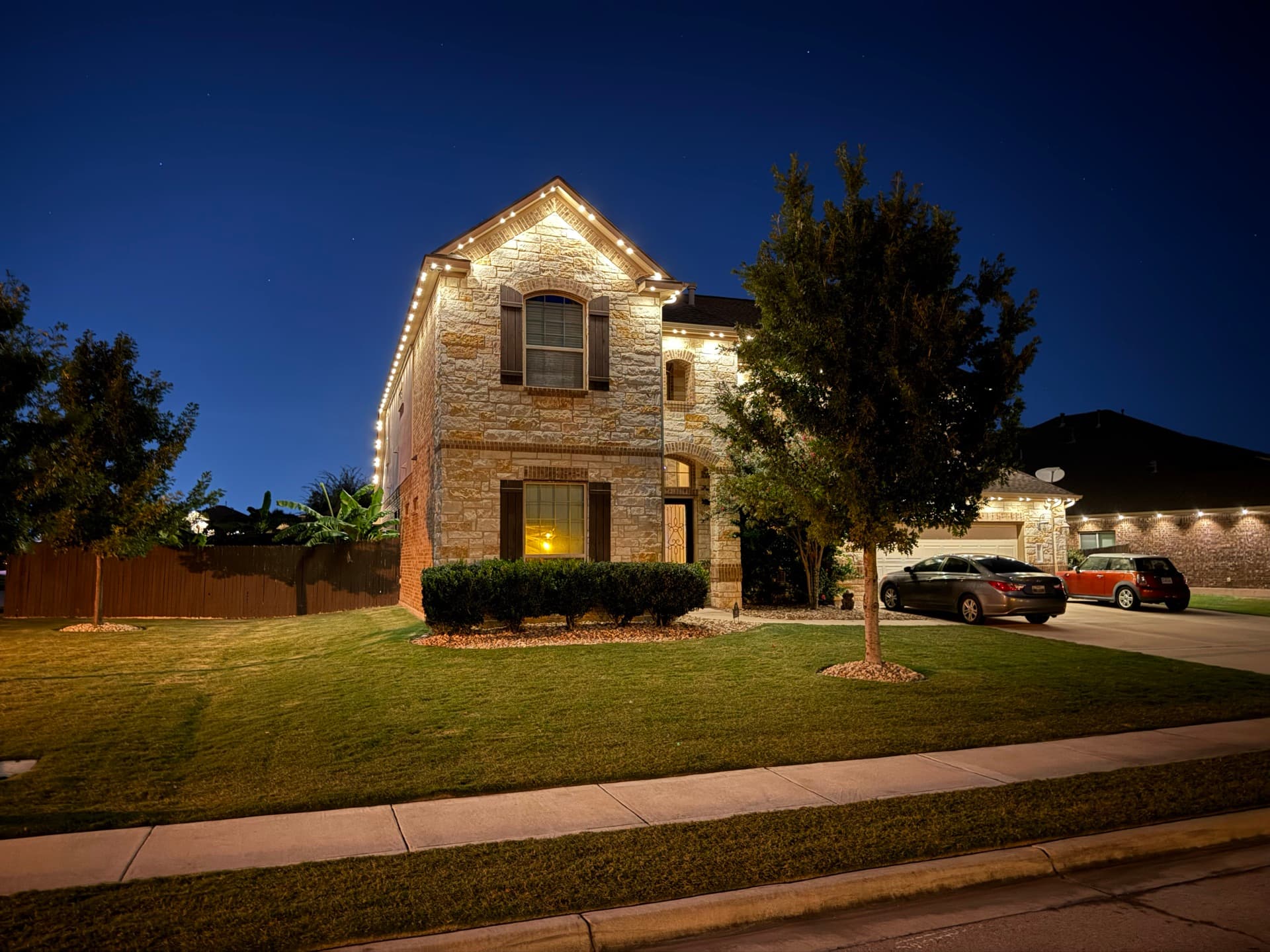
Hill Country limestone is one of the most beautiful building materials in the country. It runs in shades of warm cream, honey gold, and soft tan, with rough-cut faces that catch and hold light in the small ridges and texture across the surface. When you light it properly, every detail in that stone becomes visible, and the entire facade takes on a warm, almost candlelit quality that feels like the home is welcoming you in.
But here's the problem: most LED lighting systems default to a cool white or produce white by mixing RGB (red, green, blue) diodes together. That blended white skews blue. And when you put blue-tinted light on warm limestone, it fights the stone. The creams turn gray. The honey tones look washed out. The texture that makes Hill Country stone special flattens into something that feels cold and institutional.
This is one of the biggest reasons TruLight Austin installs RGBW systems exclusively. Our nodes run 6 LEDs: 3 RGB for full color capability, plus 3 dedicated warm white LEDs. When you set the system to warm white in the 2700K-3000K range, those warm white diodes are doing the work. Real warm white from a dedicated source, not an approximation mixed from color LEDs. On Austin limestone, the difference between real warm white and RGB-mixed white is the difference between a home that looks alive at night and one that looks like it's under a parking lot light.
If your home features any of the typical Hill Country stone colors, warm white is where you'll spend about 80% of your time. It's the everyday look. The look that makes your home feel like yours every evening when you pull into the driveway.
How Rough-Cut and Smooth Stone React Differently to Light
Not all stone is the same, and the texture of your stone matters just as much as the color when designing a lighting layout.
Rough-cut limestone, the kind with visible chisel marks, deep joints, and faces that jut out at slightly different depths, creates natural shadow play when lit from above. The light hits the raised portions of each stone face while the recesses fall into soft shadow. This gives the wall a sense of dimension and weight that's almost three-dimensional at night. It's one of those effects that makes people slow down when they drive past. The wall looks like it has depth, character, movement.
Smooth-cut or honed limestone reacts very differently. Without that surface texture to create shadow contrast, smooth stone becomes more of a reflective canvas. Light washes across it evenly, which can look beautiful and clean but requires more attention to spacing and brightness. Too many lights too close together, and smooth stone becomes a flat, overlit plane. Too few, and you get scalloping, those half-circle hot spots that are the calling card of a poorly designed system.
The same principles apply to Austin's many homes that use a combination of stone and smooth stucco. The stone sections want to be lit to emphasize texture. The stucco sections want even, softer coverage that provides warmth without creating distracting patterns on the surface.
A properly designed system accounts for these differences zone by zone along the roofline and around architectural features. It's not one brightness setting for the whole house. It's a layout that responds to what each section of the exterior actually needs.
Stucco: The Material Everyone Underestimates
Stucco is everywhere in Austin. New builds in Dripping Springs, modern homes in Cedar Park, and countless renovations across the metro area use stucco as either a primary exterior finish or a complement to stone. And most homeowners assume stucco is the easy part to light. Just put lights along the roofline and let them do their thing.
But stucco has its own personality under light, and it changes depending on the color and texture of the finish.
Light-colored stucco (white, cream, light gray) reflects a lot of light. This means you need less brightness to get a good result, but you also see every inconsistency. Uneven spacing, mismatched color temperatures, or cheap fixtures that dim at different rates will all show up more obviously on a light stucco wall than they would on textured stone.
Darker stucco (charcoal, deep brown, navy) absorbs light. You need more output to get the same visual effect, and the color of the light itself becomes more critical because the wall isn't bouncing much light back at you. On dark stucco, warm white light creates a subtle glow along the edges and contours that gives the home definition without overwhelming it. Cool white light on dark stucco tends to look sterile.
Textured stucco (skip-trowel, sand finish, dash coat) picks up shadow the same way rough stone does, though on a smaller scale. That texture means more visual interest under light, more depth, and a richer appearance after dark. Smooth stucco (the knockdown or fine-sand finish popular in newer Austin builds) is more about clean, even washes of light.
What matters here is that the lighting system has the flexibility to adjust brightness and color temperature per zone. This is where TruLight's app-based control becomes a real design tool, not just a convenience feature. You can dial each section of your home's lighting to match what the material needs.
Design Approach: Tracing Architecture, Not Just Installing Lights
The biggest misconception about permanent roofline lighting is that it's just a strip of lights along the top of the house. Straight line, all the same brightness, call it done. That approach misses the entire point of architectural lighting.
Good design follows the architecture. It traces the rooflines, yes, but it also highlights the features that give the home its shape and presence: gable peaks, stone columns flanking the entry, the transition where a front porch meets the main roofline, dormers, covered patios, and the shadow lines created by different roof elevations.
On a typical Hill Country ranch home, the roofline is long and relatively low. The lighting follows that horizontal emphasis, creating a warm, grounded look that stretches across the front of the property. The entry gets extra attention because that's where the stone work tends to be most detailed, where columns or archways create vertical elements that contrast with the horizontal roofline.
On a two-story home in West Lake Hills or Lakeway, the design changes entirely. Now you're working with multiple roof planes at different heights, often a prominent gable or two facing the street, and potentially stone on the lower level with stucco on the upper. Each elevation tells a different part of the story, and the lighting needs to make them work together as one cohesive look.
This is where permanent systems have such an advantage over landscape uplighting or temporary strings. Because the lights sit along the roofline and architectural edges, they become part of the home's silhouette. They don't just illuminate the house from the outside in. They define the shape of the house from the edges outward.
Mountain Modern vs. Hill Country Ranch: Two Different Lighting Languages
Austin's building boom over the last decade has created an interesting mix of architectural styles, and the two most common in the premium neighborhoods are traditional Hill Country ranch and what's often called mountain modern or contemporary Hill Country.
Hill Country ranch homes feature natural stone, warm earth tones, low-pitched rooflines, covered porches, and an emphasis on blending with the landscape. These homes look their best under warm white light in the 2700K range. The light should feel like an extension of the golden hour, warm and inviting, emphasizing the natural qualities of the stone and wood. Brightness should be moderate. The goal is to reveal the home's features, not blast them. Think of it as the lighting equivalent of a confident, quiet voice.
Mountain modern homes are different animals entirely. They feature cleaner lines, larger windows, mixed materials (stone and metal, stucco and glass), flat or low-slope roofs, and a design language that's more about contrast than warmth. These homes can handle slightly cooler light, up toward 3000K, and benefit from sharper definition along the architectural edges. Where a ranch home wants the light to feel enveloping, a modern home wants the light to feel precise.
Wondering what it would cost for your home? Get an instant estimate using our satellite tool. No visit required.
Get Your Free QuoteOn modern builds with large glass walls, the lighting design also has to account for reflection. Lights positioned near glass panels need careful angle consideration so the glass becomes a feature rather than a mirror that throws glare back at the street.
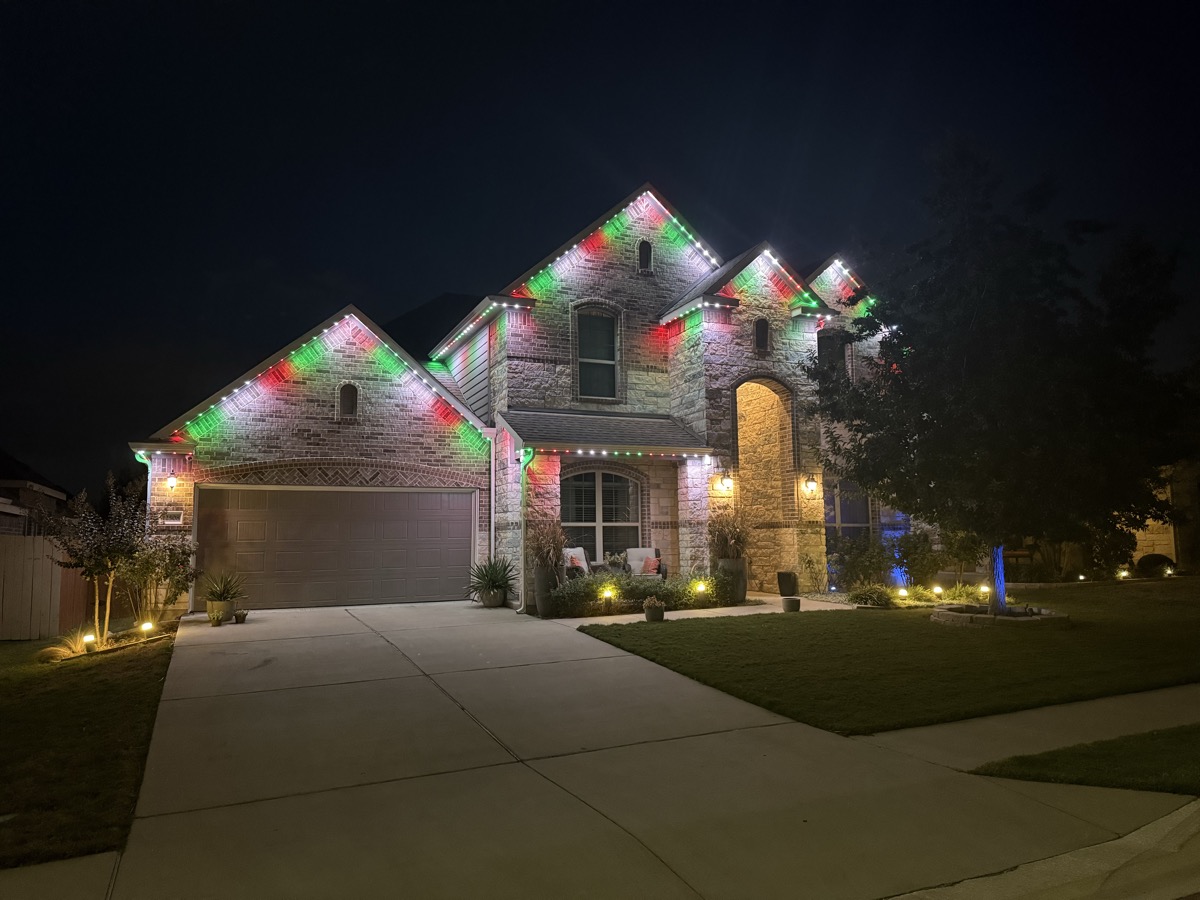
Both styles benefit enormously from RGBW flexibility. A Hill Country ranch home with a limestone and cedar exterior set to 2700K warm white on a Tuesday evening can shift to burnt orange for a UT game on Saturday, then green and red for Christmas, then back to warm white the next morning. A mountain modern home in Georgetown can run cool white daily, then drop to a deep amber for an outdoor dinner party, then hit full multicolor for a Fourth of July celebration. Same system, entirely different moods, all from the app.
The Color Temperature Sweet Spot for Austin Stone
If there's one technical detail worth understanding, it's color temperature. It's measured in Kelvin (K), and it determines whether light looks warm or cool.
Here's the quick guide for Austin's most common exterior materials:
2700K (warm white, slightly amber): Perfect for cream and honey-toned Hill Country limestone, natural cedar, and warm-toned stucco. This is the temperature that makes Austin stone look its absolute best. It's the sweet spot where the light enhances the warm undertones in the material without adding any artificial color cast.
3000K (neutral warm white): Good for lighter-colored stucco, painted brick, and modern homes with cooler-toned materials. Still warm enough to feel inviting, but with a bit more clarity. Works well on the gray and white stucco finishes common in newer Austin construction.
4000K and above (cool white): Generally too cool for Austin's warm-toned building materials. This temperature washes out the golden qualities of limestone and makes stucco look flat. There are specific situations where cooler light works (accent lighting on modern metalwork, for instance), but as a primary exterior light, it misses what makes these homes special.
TruLight's dedicated warm white LEDs sit right in that 2700K-3000K zone. Because they're dedicated diodes (not RGB-mixed white), the color temperature stays consistent over time. Cheap systems that approximate warm white by mixing colored LEDs tend to drift as individual diodes age at different rates, and you end up with sections of your roofline looking slightly pink or green compared to the rest. With dedicated warm white diodes, what you see on day one is what you see five years later.
Why Central Texas Is Especially Hard on Cheap Fixtures
This is worth mentioning because it affects every homeowner in the Austin area: the UV intensity in Central Texas is brutal on outdoor lighting hardware. We get more than 230 sunny days a year, and the UV exposure at this latitude fades plastics, degrades cheap lens covers, and yellows the diffusion material on budget fixtures surprisingly fast.
A system that looks sharp the day it's installed can look dingy and yellowed within 18 to 24 months if the hardware isn't rated for sustained UV exposure. And once the lens material yellows, the light that comes through shifts in color. Your warm white starts looking muddy. Your colors lose their saturation. The whole system starts to look tired.
TruLight's fixtures are engineered for exactly this kind of environment. The housing, lenses, and mounting hardware are built to handle sustained UV, heat cycling (Austin's 40-degree temperature swings between summer days and winter nights), and the wind-driven rain and occasional hail that come with Central Texas weather. The 100,000-hour LED rating is backed by a lifetime transferable warranty, which means the system is designed to outlast the roof it's mounted on.
For homeowners in Dripping Springs, Georgetown, and other areas west and north of Austin where there's less tree canopy and more direct sun exposure, fixture durability isn't a nice-to-have. It's the difference between a system that still looks great in year five and one you're replacing.
Motion Sensors and Security: A Natural Fit for Architectural Lighting
One feature that ties everything together for Austin homeowners is the integration of motion-sensing capability into the permanent lighting system. TruLight's system includes optional motion sensors that can trigger any lighting response you choose, full brightness on all zones, a specific color flash, or a gradual brightening that feels intentional rather than startling.
On stone and stucco homes, where the architectural lighting already provides a warm, ambient baseline, the motion response adds a functional security layer without turning your home into something that feels like a commercial property. Someone approaches the front entry, and the warm white intensifies. A car pulls into the driveway, and the perimeter lights ramp up to full output. It's visible, it's a proven deterrent, and it happens within a system that already looks great.
This matters especially in neighborhoods like Circle C, Lakeway, and Cedar Park, where homes may sit on larger lots with more perimeter area to monitor. A well-lit home with motion-responsive lighting tells anyone approaching that the homeowner is paying attention.
Living With Permanent Lighting on a Stone or Stucco Home
The day-to-day reality of owning a permanent lighting system is simpler than most people expect. Once the system is installed and dialed in for your specific home, here's what a typical year looks like for most TruLight Austin homeowners:
About 80% of the time: Warm white. Your everyday look. The setting that makes your limestone glow, defines your roofline, and gives your home presence after dark. Most homeowners set a schedule through the app and don't think about it again for months.
Fall Saturdays: Burnt orange for UT games. It takes about five seconds in the app, and your house becomes the most popular spot on the block. Some homeowners in West Lake Hills and Barton Creek have told us their neighbors text them to ask when the orange is going on so they can drive by.
Holidays: Red and green for Christmas, red white and blue for the Fourth, pastels for Easter, orange and purple for Halloween. Full color spectrum from the same system, no ladders, no tangled strands, no hiring a crew to put up and take down seasonal lights. You make the change from your phone and the house transforms in seconds.
Special events: Outdoor parties, birthdays, graduations. Set the whole house to a single color, run a slow color cycle, or create zones with different colors. The system is genuinely fun to play with once you have it.
And through all of this, the lights sit flush along the roofline, invisible during daylight hours. No visible hardware, no bulky fixtures, no wires running across the fascia. During the day, your home looks exactly the same as it always has. After dark, it comes alive.
Frequently Asked Questions
Will permanent lighting damage my limestone or stucco?
No. TruLight's mounting system is specifically designed to attach to the fascia and trim, not to the stone or stucco surfaces. The fixtures sit in the roofline where they're virtually invisible during the day. There's no drilling into stone, no adhesive on stucco, and no contact between the lighting hardware and your exterior cladding material.
Can I control different sections of my home independently?
Yes. The system is fully zone-capable through the TruLight app. You can set different brightness levels, different colors, and different schedules for each section of your home. This is especially useful on homes with mixed materials where the stone sections may need a different brightness setting than the stucco sections.
How does the system handle Austin's summer heat?
TruLight runs on a 48-volt architecture, which is significantly more efficient and generates less heat than the 12-24V systems most competitors install. The fixtures are rated for continuous operation in extreme heat, and the 100,000-hour lifespan accounts for year-round operation in climates like Central Texas. Summer heat doesn't affect performance or longevity.
What if I have an HOA?
Most HOAs in Austin-area master-planned communities permit permanent architectural lighting. The fixtures are designed to be invisible during daylight, which satisfies the most common HOA concern. TruLight Austin handles the HOA approval process as part of every installation and is familiar with the requirements in Circle C, Lakeway, Barton Creek, and other neighborhoods with active architectural review committees.
How long does installation take?
Most residential installations are completed in a single day. The system is custom-measured and pre-built for your specific roofline, so the on-site installation is efficient and clean. There's no construction mess, no multi-day disruption, and your home is fully lit that same evening.
See What Architectural Lighting Would Look Like on Your Austin Home
Every stone and stucco home is different, and the best way to understand what permanent lighting would do for yours is to see it planned for your specific exterior. TruLight Austin serves homeowners across Central Texas, from West Lake Hills and Lakeway to Dripping Springs, Georgetown, Cedar Park, and everything in between.
Request a free, no-obligation quote and we'll walk you through exactly how a custom architectural lighting design would work with the stone, stucco, and features on your home. No pressure, just a conversation about what's possible.
Ready to Light Up Your Home?
Use our light preview tool to see your home in warm white, holiday colors, and more. Then get your free instant quote.
Get Your Free Quote Instantly