
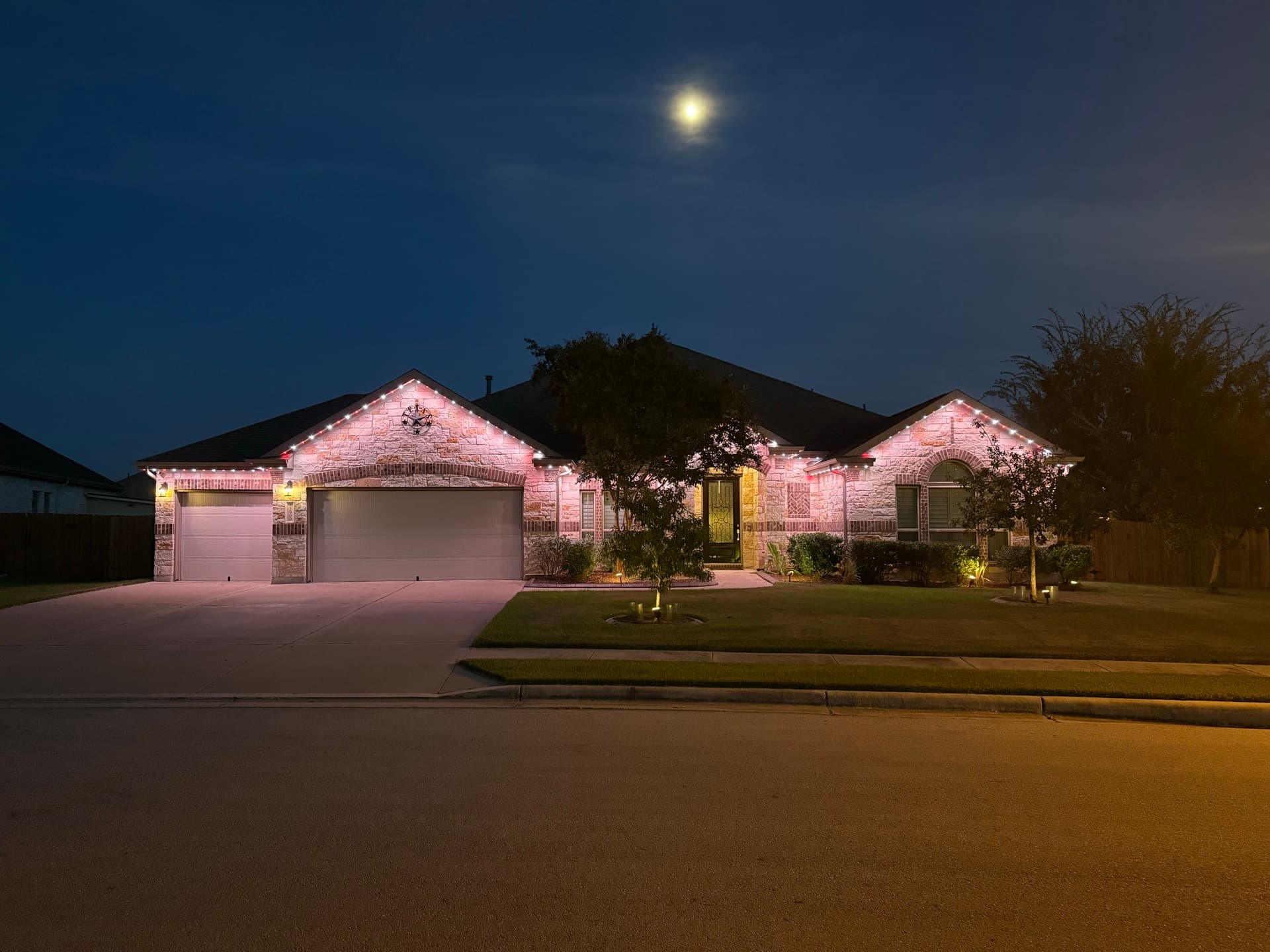
See Your Austin Home in a Whole New Light
You've Heard the Rumors. Let's Talk About What's Actually True.
Somewhere between a neighborhood Facebook group and a conversation with your brother-in-law at a cookout, you've probably heard a few things about permanent roofline lighting that gave you pause. Maybe someone told you it damages your roof. Maybe you saw a photo of a house lit up in neon green and thought, that's not for me. Or maybe you've been curious for a while but assumed it was just expensive Christmas lights for people with more money than sense.
Here's the thing: permanent roofline lighting has been growing fast across Austin, from West Lake Hills to Georgetown to the newer neighborhoods out in Dripping Springs. And as more homes get it, more questions and misconceptions circulate. Some of them were true about older systems. Some were never true at all. And some are just the kind of thing that sounds right until you look at the details.
So let's walk through the most common myths about permanent roofline lighting and put them up against reality. No hype. Just straight answers, with Austin-specific context where it matters.
Myth 1: "It's Just Fancy Christmas Lights"
This is the big one. The assumption that permanent roofline lighting exists for the holidays and that's about it. And honestly, it makes sense that people think this way. The entire category grew out of homeowners wanting a better holiday lighting solution, and that's still how a lot of people first hear about it.
But here's the reality: the overwhelming majority of permanent lighting homeowners run their system in warm white most of the time. Not red and green. Not flashing rainbow. Just a clean, warm glow along the roofline, every evening, all year long.
Think about how your house looks at night right now. Probably a porch light on, maybe some landscape spotlights, and a whole lot of dark roofline. Now picture that same house with a soft, consistent warm white glow tracing the entire roofline and eaves. On an Austin Hill Country home with limestone or natural stone, that kind of accent lighting is genuinely beautiful. It turns the architecture itself into the focal point.
The holiday stuff? That's maybe 20 percent of the use. Red and green in December. Red, white, and blue for the Fourth of July. Burnt orange for a UT Longhorns home game. Verde and black when Austin FC is playing. Those are fun moments, and they take about 10 seconds to set up in the app. But the other 80 percent of the year, permanent lighting is just really good-looking architectural accent lighting that happens to have a party mode built in.
Myth 2: "It Damages Your Roof"
This concern comes up a lot, and it's understandable. Nobody wants to punch holes in their house. But the reality of how permanent lighting is installed is very different from what most people picture.
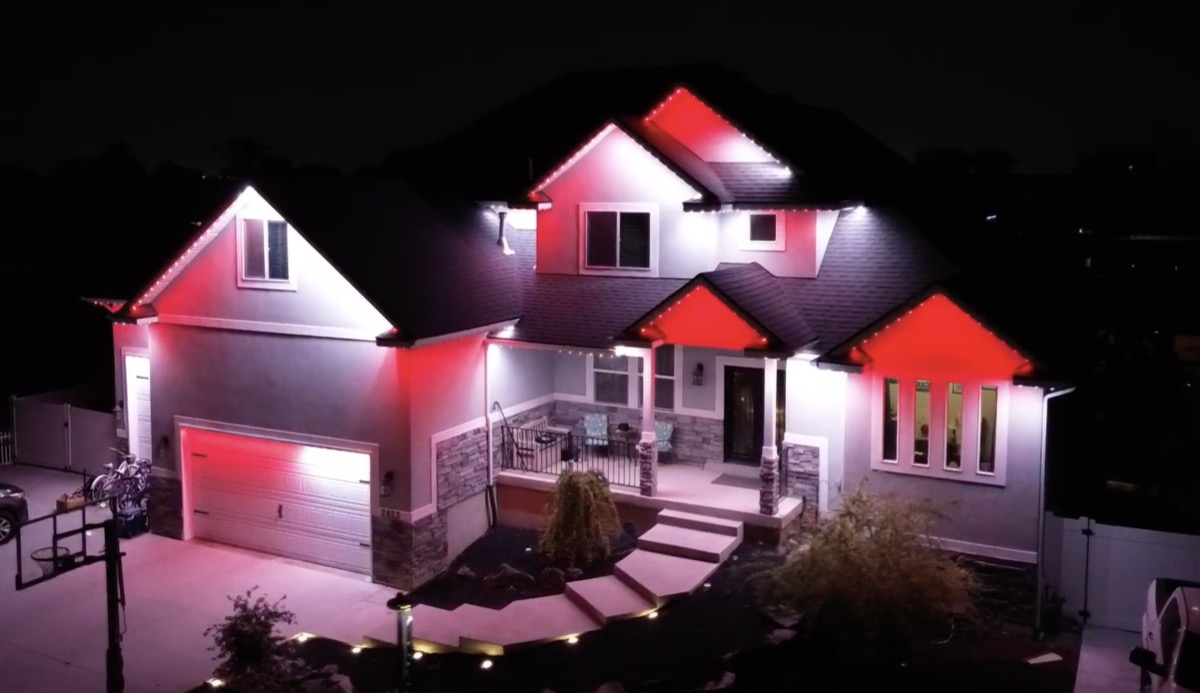
The lighting track mounts to the fascia board, not the roof surface. No shingles are drilled. No tiles are penetrated. No metal panels are touched. The fascia is the flat board that runs along the edge of your roofline, and it's already designed to have things attached to it. Your gutters are mounted to the fascia. Drip edges are fastened to it. Soffit vents connect to it. The small screws used to mount a lighting track are comparable in size to what holds a gutter clip in place.
Every mounting point gets sealed against moisture, which actually matters a lot in Central Texas where spring storms can drive rain sideways. And here's a detail most people don't think about: the track itself creates a secondary layer of protection for the fascia. It shields the wood or composite material from direct UV exposure. Given how brutal Austin summer sun is on anything facing south or west, that's a meaningful benefit. UV is one of the main reasons fascia paint peels and wood deteriorates over time.
If anything, properly installed permanent lighting is gentler on your fascia than the annual cycle of clipping on and pulling off seasonal holiday lights. That repeated attach-and-remove process is what actually scuffs paint, loosens nail holes, and stresses gutter edges over the years.
Myth 3: "It Looks Tacky and Cheap"
If you're picturing those old-school icicle lights from the 2000s that sagged between hooks and had visible green wire everywhere, that mental image is doing permanent lighting a disservice.
Modern permanent systems use a low-profile track that gets color-matched to your fascia or trim. When the lights are off during the day, most people walking past your house wouldn't notice anything is there. It's designed to disappear. The individual LED nodes sit inside the channel, completely concealed from normal viewing angles.
There are no visible wires running down your siding. No extension cords snaking across the driveway. No plastic clips popping off the gutters. Just a clean roofline with a subtle channel that's doing its job invisibly.
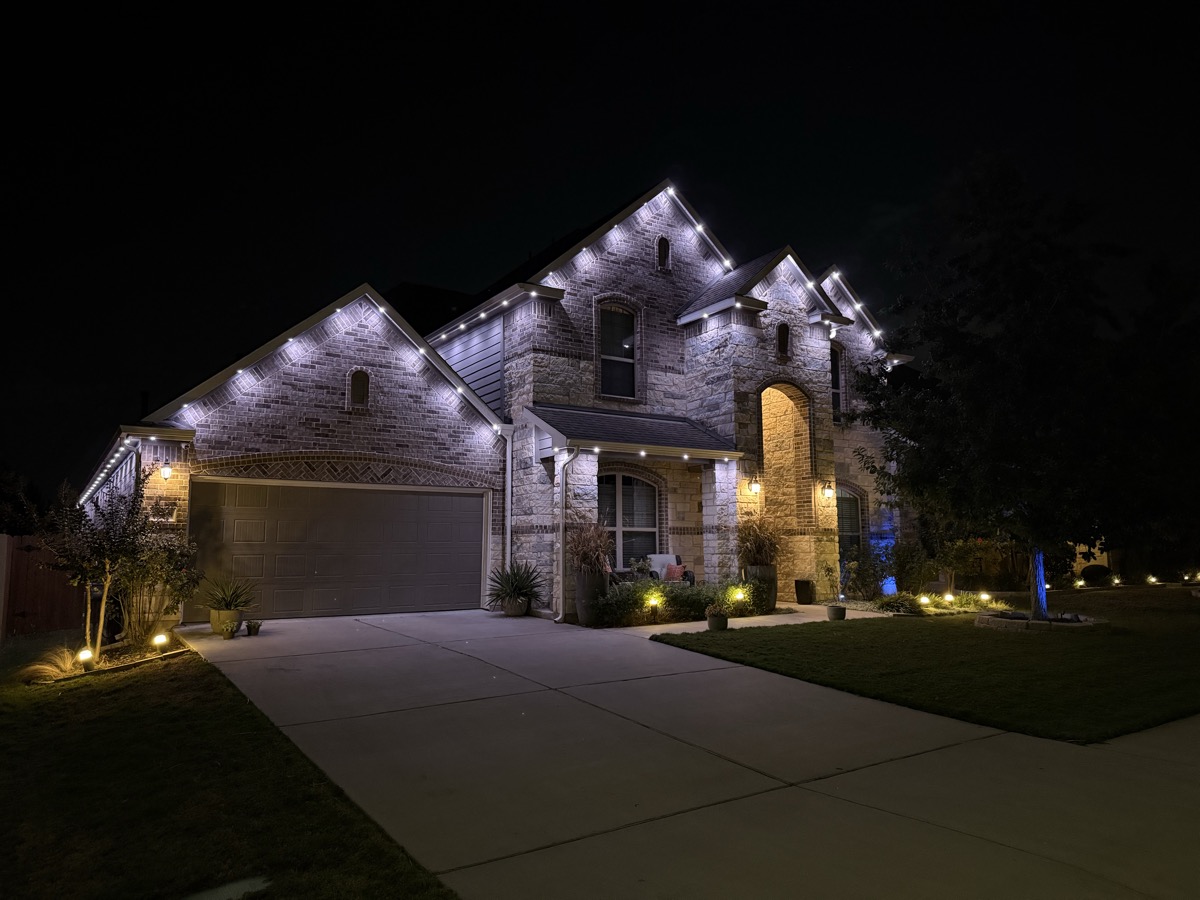
At night, the effect depends entirely on what color and brightness you choose. Running warm white at moderate brightness looks like high-end architectural lighting. It's the same kind of look that luxury hotels and upscale restaurant patios use. On the stone and stucco exteriors common across Barton Creek, Circle C, and Lakeway, warm white accent lighting makes the texture of the material pop. It's the opposite of tacky.
The homes that look overdone are almost always running full-color party mode on a random Tuesday night. That's a choice, not a limitation of the technology. It's like saying cars are too fast because someone was speeding. The system gives you total control, and what looks tasteful versus what looks like a laser tag arena is entirely up to the homeowner.
Myth 4: "It's Way Too Expensive"
Let's talk numbers, because "too expensive" is always relative to what you're comparing it to.
A typical permanent lighting installation for an Austin home runs between $2,500 and $6,000, depending on the amount of roofline, roof complexity, and the system you choose. That's a one-time cost. No annual fees. No seasonal install charges. No replacement bulbs. No storage hassle. The LEDs are rated for over 100,000 hours, which translates to decades of nightly use.
Now compare that to what seasonal lighting costs in Austin. If you're hiring a professional install-and-remove service, a single-story home runs $400 to $800 per season. A two-story home with peak accents and tree wrapping? Easily $800 to $1,200 each year. Over five years at $900 a season, you've spent $4,500 with nothing to show for it. After year five, you're still writing the same check every November.
If you're doing DIY, you're spending $150 to $400 a year on replacement strands, clips, timers, and extension cords, plus five to eight hours of your weekend on a ladder. Over a decade, that adds up to $1,500 to $4,000 in materials alone, not counting the value of your time or the risk of a ladder fall.
For homeowners who were already paying for professional seasonal lighting, permanent lighting typically breaks even in three to four years. After that, every year is free. And unlike seasonal lights that depreciate to zero the moment you take them down, permanent lighting adds value to your home. It's a permanent exterior improvement, not a disposable expense.
The homeowners who find permanent lighting "too expensive" are usually comparing it to doing nothing, not to the real cost of what they're already spending on seasonal alternatives.
Myth 5: "The Colors Look Fake and Cartoonish"
This one has a grain of truth to it, but only if you're looking at the wrong system.
Budget permanent lighting systems use RGB LEDs, which mix red, green, and blue light to produce colors. RGB does a decent job with saturated hues like red, blue, and green. But when you try to mix all three to create white? You get a cold, bluish, slightly purple-tinted "white" that looks artificial. It's fine for a Halloween display, but it's not the kind of warm, inviting glow you'd want on your home 300 nights a year.
That's the real issue. Not that colors look fake, but that white looks fake. And since warm white is what you'll run the vast majority of the time, white quality matters more than anything else in the system.
Wondering what it would cost for your home? Get an instant estimate using our satellite tool. No visit required.
Get Your Free QuoteRGBW systems solve this problem completely. Instead of 3 LEDs per node, an RGBW setup runs 6 LEDs per node: 3 RGB LEDs for color mixing, plus 3 dedicated warm white LEDs. When you want warm white, you're getting actual white light from purpose-built white LEDs, not a simulated approximation from mixing colored lights together. The difference is immediately visible. It's the difference between a warm porch light and the flickering blue glow of a gas station sign.
When you're running saturated colors for holidays or events, the RGB LEDs handle those beautifully. When you're running everyday warm white, the dedicated white LEDs take over and produce a rich, true tone that flatters stone, brick, stucco, and painted surfaces equally well. On the warm-toned limestone facades you see throughout the Austin Hill Country, RGBW warm white looks particularly natural.
If you've seen a house with permanent lighting that looked "off," there's a good chance it was an older RGB-only system trying to fake white. That's a legitimate criticism of the older technology. It's just not a relevant criticism of a modern RGBW setup.
Myth 6: "It'll Jack Up My Electric Bill"
People hear "lights on every night" and picture their Austin Energy bill climbing. It's a reasonable concern. But the math tells a very different story.
LED nodes consume remarkably little power. A typical permanent lighting system running warm white for five hours each evening uses roughly the same electricity as a single 60-watt incandescent bulb. At Austin Energy's residential rates, that works out to somewhere around $3 to $5 per month. Not per node. For the whole system.
Compare that to the old-school approach. A full display of incandescent C9 holiday bulbs on a two-story home can add $30 to $50 per month to your electricity bill during the holiday season. And those are only on for six weeks.
Even compared to other common household energy costs, permanent lighting barely registers. Your pool pump costs more to run. Your HVAC system on a 105-degree Austin afternoon uses more electricity in a single hour than your roofline lights use in a week. The refrigerator in your kitchen pulls more power overnight than the entire lighting system.
The 48V low-voltage platform that quality systems run on is part of why efficiency is so high. Low-voltage LED systems convert nearly all their input energy to light rather than heat, which is the opposite of how incandescent bulbs work (those old C9s are mostly producing heat with a side effect of light). For a city where energy consciousness is increasingly part of the culture, permanent LED lighting fits right in.
Myth 7: "My HOA Will Never Approve It"
If you live in Circle C, Steiner Ranch, Avery Ranch, Crystal Falls, or any of the dozens of planned communities across the Austin metro, you know your HOA has opinions about what goes on the outside of your house. So the assumption that they'll shut down a lighting project isn't unreasonable. It's just usually wrong.
Here's what HOA architectural review committees actually care about: daytime appearance. They want to make sure exterior modifications look clean, finished, and consistent with the neighborhood's character. The thing they're most worried about is visible hardware, sagging wires, and anything that looks temporary or jury-rigged.
Permanent lighting is literally designed to address those exact concerns. The track is color-matched, low-profile, and virtually invisible during the day. There are no wires, no clips, no extension cords. It looks like a subtle architectural detail, not a lighting display. When board members see daytime photos of completed installations, their concerns typically vanish on the spot.
The most effective strategy for HOA approval is simple: submit daytime photos of completed installations on homes similar to yours (same facade material, similar style), include a product spec sheet showing the low-voltage design and color-matching process, and note that the everyday setting will be warm white, which is no different from any other exterior accent lighting.
In practice, the vast majority of Austin HOA submissions for permanent lighting get approved without pushback. And once one home in a neighborhood gets it, the second and third approvals tend to happen even faster because the board can see the real-world result. We've seen entire streets in Cedar Park and Georgetown neighborhoods go from zero to four or five homes with permanent lighting within a single year, each approval easier than the last.
Myth 8: "It's Complicated to Set Up and Use"
This myth usually comes from people who've struggled with smart home devices that required pairing, firmware updates, Wi-Fi troubleshooting, and a PhD in app navigation just to turn on a light bulb. That frustration is valid. A lot of smart home technology is way more complicated than it needs to be.
But here's the reality of how most people actually interact with their permanent lighting system: they set it up once and then barely touch it.
The app lets you pick a color or scene, set a schedule (on at sunset, off at midnight, for example), and save it. That takes about two minutes. After that, the system runs automatically. Your lights come on every evening and turn off every night without you doing anything. Most homeowners go weeks or months without even opening the app.
When you do want to change things, it's genuinely simple. Switching to holiday colors for Thanksgiving dinner takes about 10 seconds. Setting a game-day scene for a UT watch party is a couple of taps. Going back to warm white afterward is one more tap. You can do it from the couch, from the car on the way home, or from the backyard while you're grilling.
There's no ladder involved. No climbing on the roof. No untangling anything. No plugging and unplugging extension cords. The physical system is permanently installed and maintained by the installer. Your only interaction is through the app, and the app is designed for people who just want their house to look great without thinking about it too hard.
For the tech-curious, there's more depth available. You can create custom color animations, sync lights to music, set up motion-sensor triggers for security, and program different schedules for different days of the week. But none of that is required. The "set it and forget it" approach works perfectly for homeowners who just want reliable warm white every evening without any fuss.
The Real Question Isn't Whether the Myths Are True
At this point, you've probably noticed a pattern. Most of these myths are based on how things used to be, or how cheaper systems still work, or just general assumptions that don't hold up once you look at the specifics. The older RGB-only systems really did produce weird white. The cheapest installations really can look tacky. And yes, if you're picturing a $10,000 project that only works at Christmas, the math doesn't make sense.
But a modern RGBW system with 6 LEDs per node, 48V power, color-matched track, app control, and a lifetime transferable warranty? That's a different product than what most of these myths are describing. It's permanent architectural lighting that also happens to do holidays, game days, parties, and security. And it costs pennies a night to run.
The homeowners across Lakeway, West Lake Hills, Barton Creek, and Dripping Springs who've already made the switch aren't thinking about myths anymore. They're just enjoying the way their house looks every evening. And every time a neighbor asks about it, which happens more than you'd expect, the answer is the same: "I wish I'd done it sooner."
Related Articles
If any of these myths were holding you back, consider them officially retired. And if you're ready to see what permanent lighting would look like on your home, TruLight Austin offers free consultations for homeowners across the Austin metro. We'll walk you through the system, show you what the track looks like on homes similar to yours, and give you a straight answer on cost. No pressure, no surprises, just an honest conversation about whether it makes sense for your place.
Ready to Light Up Your Home?
Use our light preview tool to see your home in warm white, holiday colors, and more. Then get your free instant quote.
Get Your Free Quote Instantly