
Permanent Roofline Lighting vs. Holiday Lights in Austin: An Honest Comparison
Every November, the Same Argument Plays Out in Driveways Across Austin
It starts around the second week of October, right when Austin finally dips below 90 degrees. You drive through Barton Creek or West Lake Hills and spot it: a neighbor balanced on an extension ladder, untangling a snarl of C9 bulbs while sweat drips down their forehead. Their spouse is holding the ladder and looking nervous. Their kids are "helping" by pulling more lights out of a plastic tub from the garage.
Two months later, that same homeowner is back on the ladder, pulling everything down in January drizzle, stuffing half-working strands into bags, and swearing they'll hire someone next year.
If this sounds familiar, you're not alone. Holiday lighting in Central Texas has always been a labor of love, heavy on the labor. But over the past few years, a growing number of Austin homeowners have started asking a different question: What if the lights just stayed up all year, looked great year-round, and handled holidays with the tap of a button?
That's the promise of permanent roofline lighting. And it's worth an honest, side-by-side look at how it actually compares to the traditional seasonal approach. No sales pitch here. Just a straightforward comparison so you can decide what makes sense for your home.
What Seasonal Holiday Lights Actually Cost in Austin (It Adds Up Fast)
Let's talk numbers, because the cost comparison is where most people start.
If you're a DIY holiday lighter, you're probably spending $150 to $400 each year on replacement bulbs, extension cords, clips, timers, and the occasional trip to Home Depot when you realize half a strand died in storage. That doesn't account for your time, which we'll get to.
If you hire a professional holiday lighting company in Austin, a typical single-story home runs $400 to $800 per season. Two stories with peak accents, ridgelines, and maybe some tree wrapping? You're looking at $800 to $1,200 or more. And that's every single year. No equity. No lasting improvement. Just a temporary display that comes down six weeks later.
Over five years, a homeowner paying $900 a season has spent $4,500 with nothing to show for it except a box of tangled lights in the attic.
Permanent roofline lighting is a one-time investment. Depending on home size and the amount of roofline being covered, a typical Austin installation runs between $2,500 and $6,000. After that, there are no annual install fees, no removal fees, no replacement bulbs, and no storage hassle. The system is rated for over 100,000 hours of use, which means decades of service before you'd need to think about it.
For most homeowners who were already paying for professional seasonal install and removal, permanent lighting pays for itself in three to five years. After that, it's all savings.
The Austin Heat Factor: Why November Install Season Is Miserable
Here's something the holiday lighting comparison articles written for the Northeast never mention: in Austin, the timing is brutal.
Most people want their holiday lights up by Thanksgiving. That means you're installing in late October or the first half of November. And in Central Texas, late October can still hit 95 degrees. You're up on a ladder, in direct sun, wrestling with clips and extension cords, on a roof that's been absorbing heat all day.
It's genuinely dangerous. Heat exhaustion on a ladder is not a joke, and every year ERs across Texas treat falls from ladders during holiday decorating season. The Consumer Product Safety Commission estimates over 14,000 ladder-related injuries from holiday decorating nationally each year.
With permanent roofline lighting, the installation happens once, on a timeline that works for the installer and the weather. Professional installers typically mount the track system during milder months. Once it's up, it's up. You never climb a ladder for lighting again. Changing colors for Christmas, the Fourth of July, or a UT game day is done from your phone, sitting on the couch with the AC running.
That's not just convenience. For a lot of families, especially those with older homeowners or steep rooflines common in the Hill Country builds around Lakeway and Dripping Springs, it's a real safety improvement.
Six Weeks of Use vs. Twelve Months of Use
This is the part of the comparison that often gets overlooked, and it might be the most important one.
Seasonal holiday lights serve one purpose: they look festive from roughly November through mid-January. That's about six weeks out of a 52-week year. For the other 46 weeks, your roofline is bare, and those lights are sitting in a box somewhere.
Permanent roofline lighting is always there, ready to go. And because modern systems offer full color control through a phone app, the use cases extend well beyond the holidays:
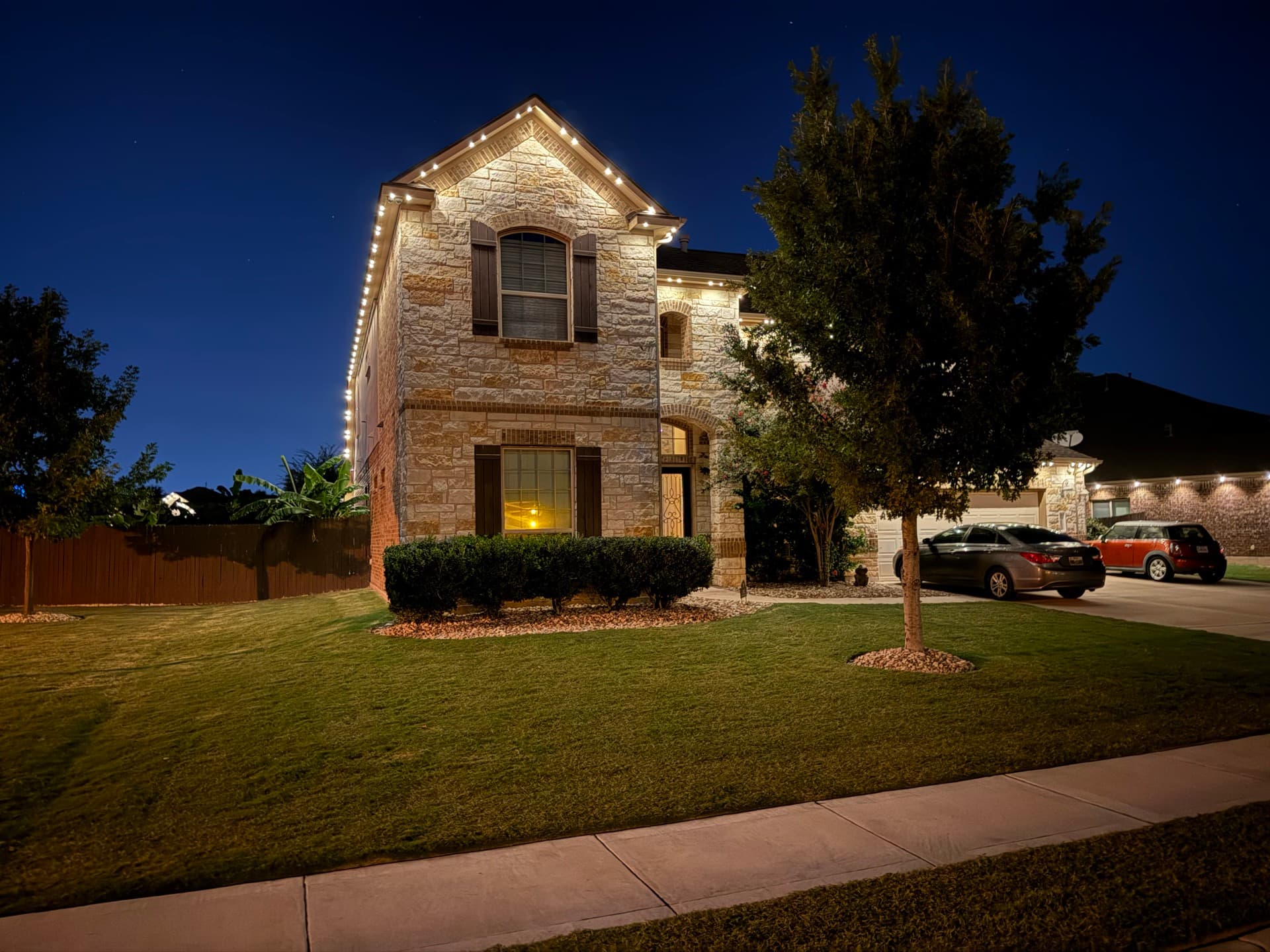
- Everyday accent lighting. A warm white glow along your roofline every evening adds curb appeal that you (and your neighbors) see year-round. On Hill Country limestone or natural stone facades, warm white light is particularly striking.
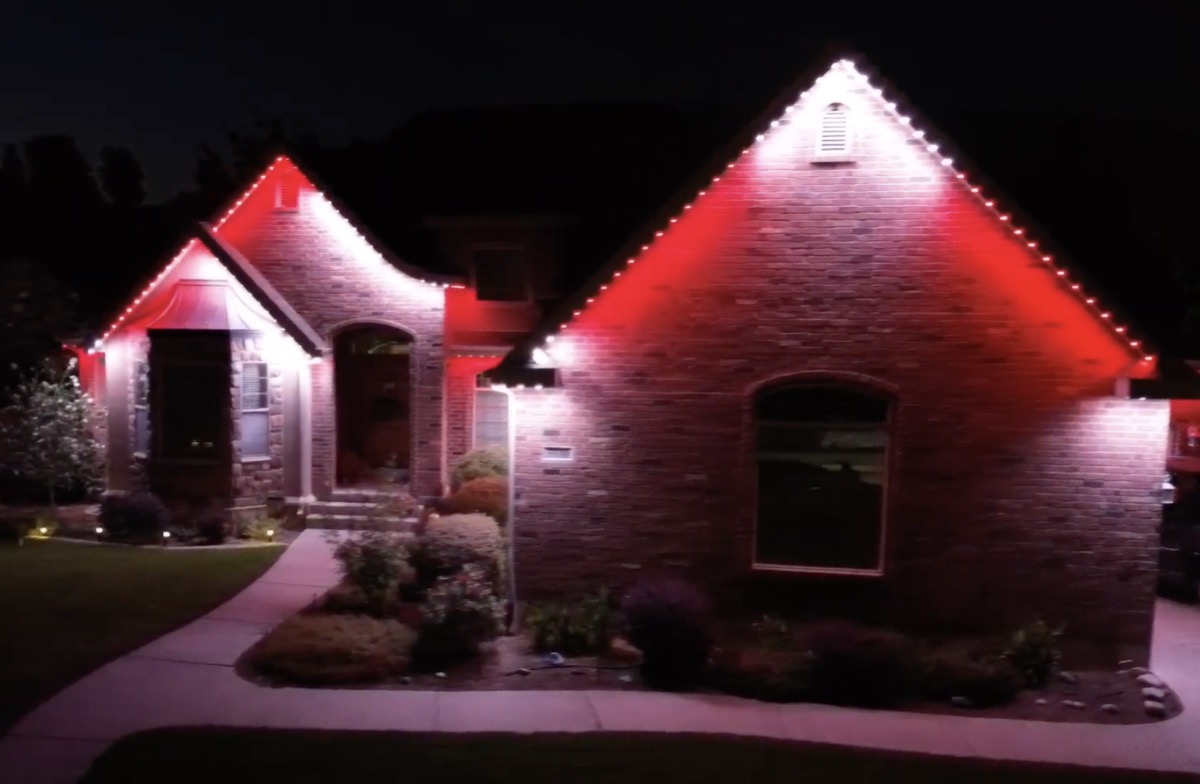
- Holidays and seasons. Red and green for Christmas. Red, white, and blue for the Fourth. Orange and purple for Halloween. Pastels for Easter. Whatever you want, changed in seconds.
- Austin events and game days. Burnt orange for UT Longhorns home games. Verde and black for Austin FC matches. Teal and purple for SxSW week. Your house becomes part of the local culture.
- Parties and gatherings. Hosting a backyard BBQ? Set the roofline to a color that complements your patio lighting. Having a birthday party? Match the party's color theme.
- Security. Some permanent systems include motion sensor integration, so the lights can brighten or flash if motion is detected at night. That's a real deterrent that seasonal string lights simply can't provide.
When you spread the cost of permanent lighting across 365 days of potential use instead of 42 days, the value equation changes dramatically.
Austin Weather vs. Your Holiday Lights: A Mismatch
Austin's weather is beautiful for about seven months of the year. But those other five months? They can be punishing on outdoor lighting.
Summer UV in Central Texas is intense. Cheap plastic clips become brittle and crack. Colored bulb coatings fade. Wire insulation degrades. If you've ever pulled holiday lights out of the garage in October and found that half the strand doesn't work anymore, UV damage and heat exposure during storage are usually the culprits.
Then there are the storms. Austin averages significant severe weather events each spring and fall, with hail, high winds, and heavy downpours. Seasonal string lights that are clipped (loosely, usually) to gutters and shingles aren't built for 60 mph wind gusts. After a good spring storm, you'll see strands dangling from rooflines across Circle C and Cedar Park.
Wondering what it would cost for your home? Get an instant estimate using our satellite tool. No visit required.
Get Your Free QuotePermanent roofline lighting is built for this. The track mounts directly to the fascia or roofline with architectural-grade hardware. There are no clips to pop off, no sagging wires, no exposed connections. The LEDs themselves are rated for outdoor exposure, UV-stable, and sealed against moisture. A system running on a 48-volt low-voltage platform is inherently more weather-resistant than standard 120V holiday lights, and significantly safer during wet conditions.
The same storm that rips seasonal lights off your neighbor's gutters won't faze a properly installed permanent system. That durability matters in a market like Austin where weather can turn quickly and violently.
How They Actually Look: Aesthetics Side by Side
Let's be real about what seasonal holiday lights look like on a house. From 50 feet away, at night, with the lights on? Pretty great. Up close, during the day? Not so much.
Visible plastic clips along the gutter line. Wires sagging between attachment points. Extension cords snaking down the side of the house to an outlet. Green or white wire that doesn't quite match your trim color. Maybe a strand or two that isn't working, creating dark gaps in the display.
It's charming in a nostalgic way, and there's nothing wrong with that if you enjoy the traditional look. But it's not what most people would describe as a clean, finished appearance.
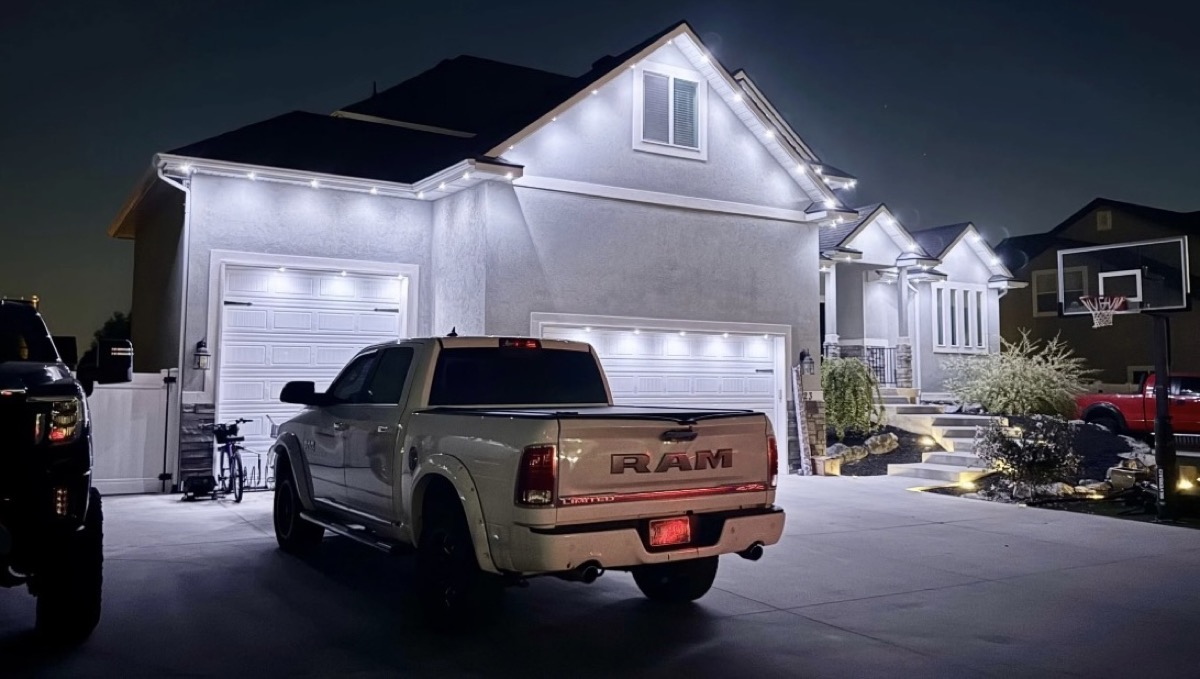
Permanent roofline lighting takes a different approach. The track system is designed to be virtually invisible during the day. It's typically color-matched to your fascia or trim, so when the lights are off, most people walking by wouldn't even notice anything is there. The individual LED nodes sit inside a low-profile channel. No visible clips, no sagging wires, no extension cords. Just a clean roofline that happens to produce beautiful light when you want it to.
For the types of homes common in Austin's nicer neighborhoods, from modern builds in West Lake Hills to Texas ranch-style homes in Georgetown to limestone-clad houses in Barton Creek, that clean daytime appearance matters. The light display should add to your home's look, not detract from it during daylight hours.
If you're curious about how permanent lighting looks on homes similar to yours, TruLight Austin's website has photos of real local installations across a range of architectural styles.
The Technology Gap: Why Not All Permanent Systems Are Equal
If you're starting to lean toward permanent lighting, here's one more thing worth understanding: there are meaningful differences between permanent lighting systems on the market.
The most common setup you'll see from budget installers uses RGB LEDs, typically with 3 LEDs per node. RGB can produce a wide range of colors by mixing red, green, and blue light. But here's the catch: RGB can't produce a true, clean white. When you mix all three RGB colors together, you get a bluish, slightly purple-tinted "white" that looks noticeably off. It's fine for party colors, but it's not the warm, inviting glow you'd want illuminating your home every evening.
That's why the RGBW configuration matters. An RGBW system uses 6 LEDs per node: 3 RGB LEDs for color, plus 3 dedicated warm white LEDs. This gives you two distinct white modes. You can run the warm white LEDs alone for a rich, warm glow that flatters stone, stucco, and earth-tone exteriors. Or you can fire all 6 LEDs together, blending warm white with RGB cool white to produce a true pure white that no 3-LED RGB system can replicate. The result is also 2 to 3 times brighter than standard RGB setups.
If you're investing in permanent lighting that you'll use year-round, the white quality matters more than anything. Holiday colors are fun for a few weeks. But warm white accent lighting is what you'll run 300+ nights a year. Make sure the system you choose does white beautifully.
Voltage matters too. Most budget systems run on 12V or 24V, which means they need extra power injection points on longer rooflines to keep brightness consistent. That adds complexity and cost to the install. A 48V system can power longer runs from a single source, which means consistent brightness from one end of your roofline to the other and a cleaner installation, even on the larger homes common in Kyle, Buda, and the newer developments south of Austin.
Frequently Asked Questions
Can permanent roofline lights really replace my holiday lighting?
Absolutely. With full color control through a phone app, you can create classic holiday looks (solid red and green, alternating candy cane, twinkling white, slow color fades) with a single tap. Many homeowners tell us their permanent lighting actually looks better than their old seasonal display because the coverage is more even, the brightness is consistent, and there are no dark spots from burned-out bulbs. You can even save your favorite holiday scenes in the app and activate them year after year.
Will the lights damage my roof or fascia?
No. The track system mounts to the fascia board with small screws, similar to how you'd mount a gutter guard or drip edge. There's no drilling into shingles, no adhesive that could damage paint, and no clips that stress your gutter edges. The mounting points are sealed against moisture. By contrast, seasonal light clips can actually cause more fascia wear over time because they're attached and removed repeatedly, year after year.
What happens if an LED node fails?
Individual nodes on a quality permanent system are independently addressable and replaceable. If one node stops working (which is rare given the 100,000+ hour lifespan), it doesn't take out the rest of the strand like a traditional string light. A technician can swap just that node in minutes. Look for a system that comes with a lifetime warranty for full peace of mind.
Do permanent lights increase my Austin Energy bill?
The impact is minimal. LED nodes consume very little power compared to traditional incandescent holiday bulbs. A typical permanent system running warm white for five hours each evening costs roughly $3 to $5 per month on Austin Energy rates. Compare that to a full display of incandescent C9 bulbs, which can add $30 to $50 per month to your electricity bill during the holiday season. The LED system is dramatically more efficient.
Related Articles
If you've been going back and forth on this decision, you're in good company. A lot of Austin homeowners make the switch after one too many seasons of wrestling with ladders, replacing dead strands, and writing checks to seasonal installers. The math, the convenience, and the year-round enjoyment all point in the same direction. If you'd like to see what permanent roofline lighting would look like on your home, TruLight Austin offers free consultations for homeowners across the Austin metro, from Georgetown down to Buda and everywhere in between. No pressure, just an honest conversation about whether it's the right fit for your home.
Ready to Light Up Your Home?
Use our light preview tool to see your home in warm white, holiday colors, and more. Then get your free instant quote.
Get Your Free Quote Instantly