Austin HOA and Roof Guide for Permanent LED Outdoor Lighting
Before You Install Permanent Lighting in Austin, Read This HOA and Roof Guide
You found the perfect permanent LED lighting system. You can picture your home glowing in warm white every evening, burnt orange on UT game days, and full holiday colors in December. There's just one thing standing between you and that vision: your HOA board and whatever's happening on your roof.
If you live in Circle C Ranch, Steiner Ranch, Avery Ranch, Crystal Falls, Rancho Sienna, Sweetwater, Travisso, or any of the dozens of master-planned communities across the Austin metro, your home improvement plans go through an architectural review committee before they go anywhere else. And even if your neighborhood doesn't have an HOA, the type of roof and fascia on your home still affects how permanent lighting gets installed.
This guide covers all of it: what your HOA actually cares about, how to get approval on the first try, what Austin's permitting rules look like, which roof types work best, what fascia materials you'll encounter, and how Texas weather factors into everything. By the time you finish reading, you'll have a clear picture of what the process looks like from start to finish.
What Austin HOAs Really Care About With Permanent Lighting
Let's clear up the biggest misconception first. Most HOA boards in the Austin area are not opposed to permanent outdoor lighting. What they oppose is anything that looks cheap, temporary, or out of place during daylight hours. When a board member hears "lights on a house," the first image in their head is sagging Christmas strands stapled to gutters with visible extension cords running down the siding. That's the kind of thing that generates complaint letters and lowers property values.
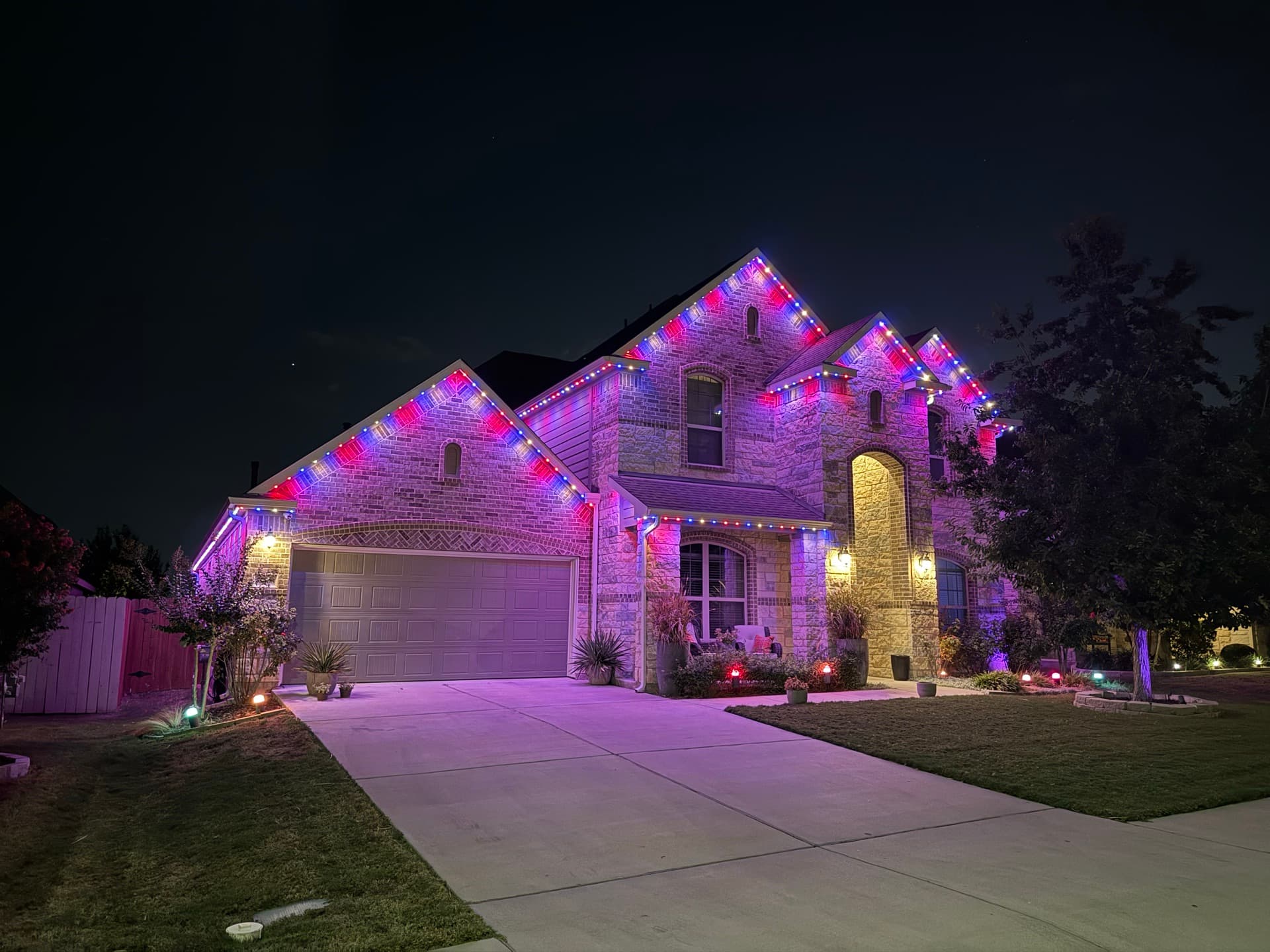
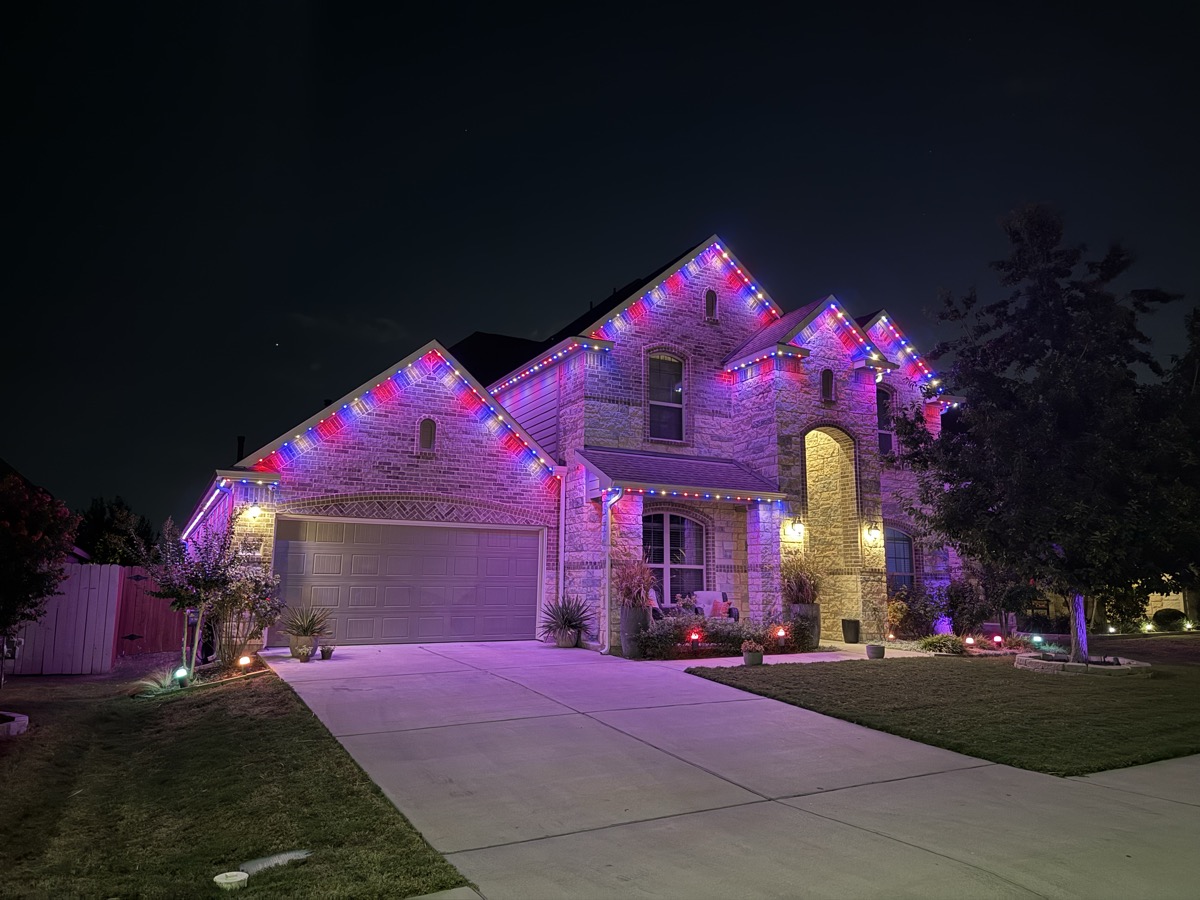
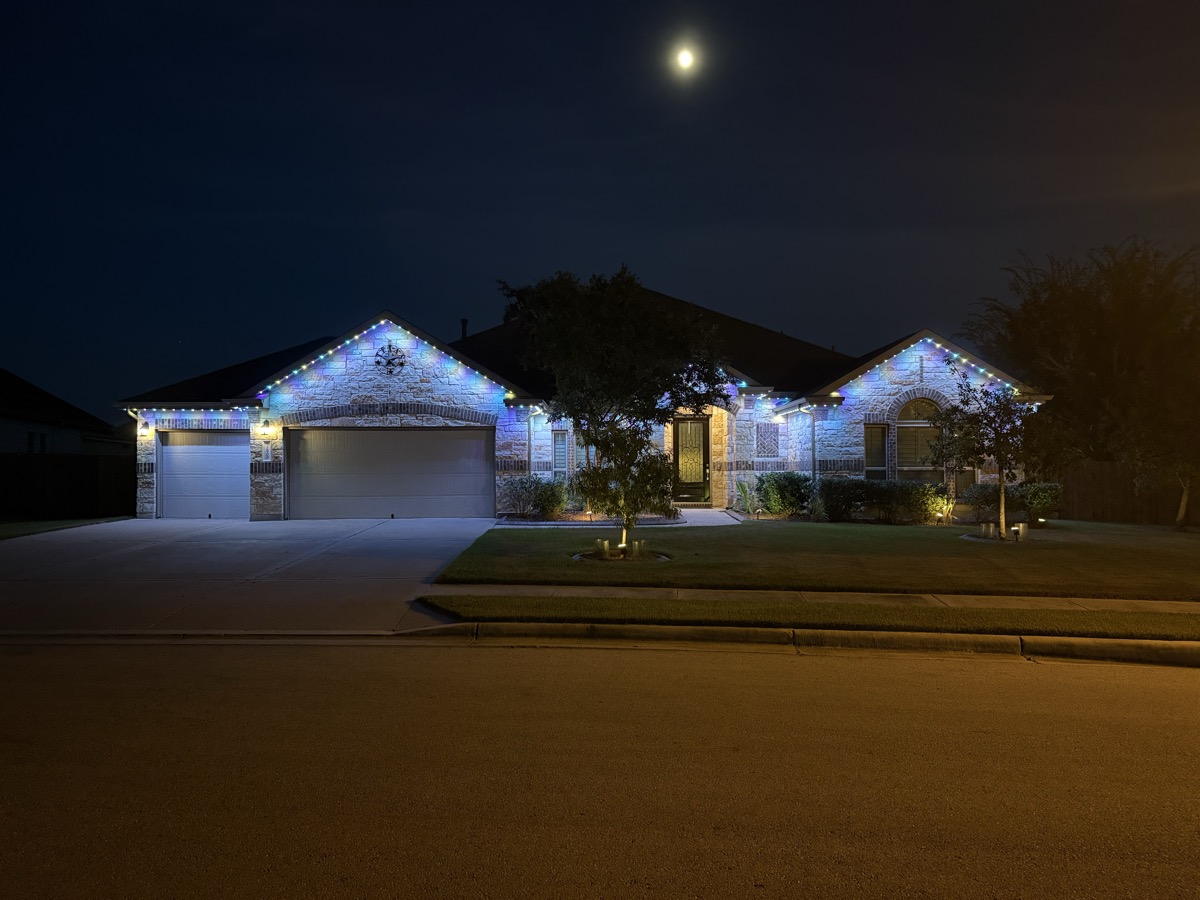
Permanent LED lighting is the opposite of that picture. The track mounts flush against the fascia board, color-matched to your trim. During the day, someone could walk right past your house and never notice it's there. No dangling wires. No plastic clips. No bulky fixtures. It reads as a subtle architectural detail, not a lighting display.
When boards in communities like Avery Ranch, Crystal Falls, or Sweetwater sit down to review a permanent lighting submission, they're evaluating three specific things:
- Daytime visibility. Can you see the system when the lights are off? With a properly installed low-profile track, the answer is almost always no. The track tucks under the drip edge and blends with the fascia color.
- Brightness and light trespass. Will the lights spill into neighboring windows or create a nuisance? Permanent LED systems are directional. They wash light downward along the facade, not outward toward the street or sideways toward the house next door. And brightness is adjustable from your phone.
- Color display guidelines. Some HOAs have rules about seasonal decorations and colored lighting. The standard everyday setting for permanent lighting is warm white, which looks like any other tasteful exterior accent light. Color displays for holidays, game days, or events typically fall under the same seasonal decoration rules that already exist in your CC&Rs.
The reality is that permanent lighting makes the neighborhood look better, and HOA boards know it. Once one home in a community gets it installed, the board usually starts seeing approval requests from three or four more homeowners within a few months. It raises the standard for the whole street.
Getting HOA Approval on the First Try: A Step-by-Step Approach
You can make this easy on yourself and the board. The homeowners who breeze through approval in a single review cycle all do the same things. Here's the playbook.
Pull your CC&Rs and read the exterior modification section
Before submitting anything, look up your community's Covenants, Conditions, and Restrictions. Find the sections on exterior modifications, lighting, and architectural changes. Most CC&Rs in Austin master-planned communities were written before permanent LED lighting existed as a category. That's actually a good thing, because there's typically no explicit prohibition. Your submission just needs to demonstrate that the modification fits within the general guidelines for exterior improvements.
Include daytime photos from completed installations
This is the most powerful thing you can include. Daytime photos of a finished installation on a home with a similar exterior to yours. Stone facade? Show them a photo on stone. HardiePlank siding? Get one on HardiePlank. Board members are visual decision-makers. When they can see that the track disappears against the fascia during daylight hours, the concern about appearance goes away on the spot.
Attach a product specification sheet
A one-page summary that explains what the system is, how it mounts, the voltage (48V low-voltage), and how the track is color-matched to existing trim. This gives the board documentation for their records and shows you've done your homework. Include the fact that TruLight uses 6 LEDs per node (3 RGB + 3 dedicated warm white) and runs a 48V system, which is significantly safer and more efficient than the 12-24V systems some companies install.
Address color use before they ask about it
If your HOA has seasonal decoration policies, acknowledge them directly in your submission. Something like: "The system will run warm white for everyday use. Holiday color displays will follow the seasonal decoration schedule outlined in the CC&Rs." This tells the board you understand the rules and plan to respect them. It eliminates the most common follow-up question before it gets asked.
Frame it as a property value improvement
HOA boards exist to protect property values. Permanent outdoor lighting is a home improvement, not a decoration. When the board sees it framed as an upgrade that benefits curb appeal and neighborhood aesthetics, the conversation shifts from "should we allow this?" to "this is actually good for the community."
TruLight Austin works with homeowners on HOA submissions regularly. We know what boards in Circle C, Steiner Ranch, Rancho Sienna, and Travisso want to see, and we're happy to provide photos, spec sheets, and support materials for your application.
Austin Permitting: Simpler Than You Think
This is the part that surprises almost everyone, and it's good news.
The vast majority of permanent outdoor lighting installations in the Austin area require no building permit. The reason is simple: the system runs on 48V low-voltage power, fed by a transformer that plugs into a standard 120V exterior outlet. It's functionally the same as plugging in landscape lighting. If your home already has an outdoor outlet near the electrical panel or on an exterior wall (and most Austin homes built in the last 20 years do), the installation connects to existing infrastructure without any new wiring.
No City of Austin building permit. No Travis County inspection. No waiting weeks for approval paperwork.
The only scenario where a permit enters the picture is when your home doesn't have a suitable exterior outlet and a new dedicated circuit needs to be run from the breaker panel. Running new electrical wiring does require an electrical permit through the City of Austin's Development Services Department (or Travis County, for unincorporated areas like parts of Bee Cave, Lakeway, or Dripping Springs). Your installer or a licensed electrician handles that process. It's standard and typically adds just a few days to the overall timeline.
For roughly 80 to 90 percent of Austin homes, the existing outlet setup works fine. Homes in newer communities like Crystal Falls, Rough Hollow, and the developments along the 45 corridor are especially well set up, since builders have been including exterior outlets as standard for years.
The bottom line: don't let permit anxiety hold up your project. In most cases, there's nothing to permit.
Roof Types Across Austin and How They Affect Installation
One of the questions we hear most often is "Will permanent lighting work on my roof?" The answer is yes for every common Austin roof type, but the installation approach varies depending on what's up there.
Composition Shingle
This is by far the most common roof material in the Austin metro. From Round Rock to Kyle, most homes have composition shingles. Installation is straightforward. The track mounts to the fascia board, not the shingles themselves. The shingle overhang at the drip edge creates a natural shadow line that helps conceal the track when viewed from below. Standard mounting hardware, clean install, no special considerations.
Metal Roofing
Standing seam metal roofs have surged in popularity across the Hill Country, East Austin, and modern builds in Mueller, Dripping Springs, and Bee Cave. The key factor with metal: thermal expansion. Metal panels expand and contract as temperatures swing (mid-30s in winter to well past 110 in summer). The lighting track still mounts to the fascia, never to the metal panels. Experienced installers leave appropriate clearance between the track and the roof edge, using brackets that accommodate slight thermal movement so the system handles seasonal shifts without stress.
Wondering what it would cost for your home? Get an instant estimate using our satellite tool. No visit required.
Get Your Free QuoteConcrete and Clay Tile
Tile roofs show up on Mediterranean and Spanish Colonial homes throughout Westlake, Barton Creek, and parts of Steiner Ranch. Since permanent lighting attaches to the fascia, no tiles are drilled, cut, or touched during installation. The installer works along the eave line without stepping on tiles. Homes with significant tile overhang may need extended mounting brackets to position the track at the right angle for optimal downward wash, but that's a minor adjustment that any experienced crew handles without issue.
Flat Roofs
Flat-roof designs are common in modern construction across East Austin, South Congress, and newer contemporary builds. Without a traditional drip edge or overhang, the track attaches directly to the fascia face or parapet wall. Color-matching is especially important here since there's no overhang to help conceal the track during the day.
Fascia Materials and What They Mean for Mounting
The fascia board is the actual mounting surface for permanent lighting, so the material matters. Here's what you'll find on Austin homes and how each one handles the installation:
- Wood fascia. Found on older homes and custom builds throughout Austin. Standard screw mounting works well. The only consideration is condition. If the wood is rotted, soft, or warped, it needs repair before the track goes up. A good installer identifies this during the initial walkthrough, not on installation day.
- Fiber cement (HardiePlank) fascia. Common on mid-range to premium Austin construction. This material requires pre-drilling to prevent cracking, which adds a small amount of time but produces a rock-solid mount. HardiePlank handles heat, moisture, and UV without flinching, making it one of the best fascia materials for permanent lighting.
- Composite/engineered fascia (LP SmartSide and similar). Increasingly standard in new builds across Leander, Liberty Hill, and Georgetown. Holds screws well, resists rot, and stays dimensionally stable through temperature swings. This is the ideal mounting surface.
- Stucco-clad fascia. Some Austin homes, particularly those with full stucco exteriors, have stucco applied over the fascia area. Installation requires careful fastening through the stucco layer into the substrate beneath. Pre-drilling and proper sealing at each mounting point keeps moisture from getting behind the stucco.
- Aluminum or vinyl fascia wrap. Common on homes built in the 1990s through 2010s. The track mounts through the wrap into the wood underneath using slightly longer fasteners. The wrap material is thin enough for a clean, flush result.
- Stone or masonry trim. Some Hill Country homes extend stone or ledger stone up to or near the roofline. In these cases, mounting brackets may be adapted to attach to adjacent fascia sections or use masonry-rated anchors where the track meets stone trim areas.
Regardless of fascia material, every mounting point gets sealed to prevent moisture intrusion. In Central Texas, where spring storms can push rain sideways at impressive angles, that weatherproofing seal is not optional.
Weatherproofing for Texas: UV, Heat, Hail, and Thunderstorms
Anything you attach to the outside of an Austin home needs to handle what Central Texas throws at it, and the weather here doesn't pull punches.
UV exposure. We get over 230 sunny days a year, and the UV intensity at this latitude degrades cheap materials fast. Plastic fixtures yellow and crack within two to three years. Budget lens covers fog over and shift the color of the light they transmit. TruLight's fixtures use UV-stabilized housing and sealed LED enclosures that maintain color accuracy across 100,000+ hours of rated life, even under years of direct Texas sun.
Summer heat. Roof-adjacent surfaces regularly exceed 150 degrees on a summer afternoon. The 48V system architecture handles this better than lower-voltage competitors. Lower voltage means higher current, which means more heat buildup in wiring and connections. At 48V, the system runs cooler and more efficiently under sustained high temperatures. Professional installation crews in the Austin market start at dawn during peak summer and schedule around the worst afternoon heat for safety and for the quality of the installation.
Hail. Austin sits squarely in what insurance companies call Hail Alley. Spring storms regularly hammer neighborhoods across Round Rock, Pflugerville, Cedar Park, and Georgetown. The low-profile design of permanent lighting track presents minimal surface area to hail impact. It handles the same events that your shingles, gutters, and siding survive. And if a severe event does damage a section, individual nodes or track segments can be replaced without redoing the whole system.
Thunderstorms and wind-driven rain. Central Texas spring weather brings straight-line winds over 60 mph, intense downpours, and rain that drives horizontally. Because permanent lighting is mechanically fastened to the fascia (not clipped to gutters with plastic hooks), it handles wind loading without issue. Sealed electrical connections keep water out, and the 48V low-voltage design is inherently safer in wet conditions than any system running on 120V line voltage.
This durability isn't theoretical. TruLight backs every installation with a lifetime warranty, and the system is rated for 100,000+ hours. That means the lights are engineered to outlast the roof they're mounted on.
Timing Your Installation: Why Spring and Early Summer Work Best
You can install permanent lighting any time of year in Austin, but there are real advantages to booking in spring or early summer. The weather is manageable for the installation crew (working on rooflines in July and August is a different experience entirely). Installer availability is generally better before the fall rush, when holiday-season demand spikes. And you'll have the system up and running well before football season, Halloween, Thanksgiving, and Christmas, which means you get to enjoy the full annual cycle of colors your first year.
If you're going through an HOA approval process, starting in spring also gives you a comfortable buffer. Submit your application, get approval in one or two review cycles, and schedule installation before summer heat or fall schedules complicate things.
Frequently Asked Questions
My HOA has never approved permanent lighting. Will they reject mine?
Being the first submission actually works in your favor if you handle it right. Provide daytime photos, a spec sheet, and a clear description of the everyday warm white appearance. Once the board sees the finished product on your home, they'll have a reference point that makes future approvals even easier. We've seen this pattern repeat across Circle C, Avery Ranch, Rancho Sienna, and many other communities.
What if my HOA bans "holiday lights" outside specific dates?
Permanent lighting is not holiday lighting. It's a permanent exterior fixture, similar in classification to a porch light or landscape lighting. Your everyday warm white setting falls squarely in the "exterior accent lighting" category. When you run holiday colors for Christmas or the Fourth of July, those displays follow your HOA's seasonal decoration window. But the warm white you use the other 300+ days a year? That's just your house lights.
Will mounting the track damage my roof or void my warranty?
No. The track mounts to the fascia board, which is a separate component from the roofing material. No shingles, tiles, or metal panels are penetrated, drilled, or modified. Mounting items to the fascia (gutters, drip edges, soffit vents) is standard building practice that doesn't affect roof warranties.
Do I need a permit in unincorporated Travis County vs. inside Austin city limits?
Only if new electrical circuits are being added. Inside Austin, permits go through the Development Services Department. In unincorporated areas (parts of Bee Cave, Lakeway, Dripping Springs), the county handles permitting. In both cases, the vast majority of installations plug into existing outlets and require no permit at all. Your installer will know which jurisdiction applies and manage the process if anything is needed.
How does the system hold up in Austin's summer heat?
TruLight runs on a 48V architecture, which is more efficient and produces less heat than the 12-24V systems most competitors install. The fixtures are rated for continuous operation at the temperatures Austin's climate demands, and the 100,000+ hour lifespan accounts for year-round use in this kind of heat. Summer temperatures don't affect performance or longevity.
Related Articles
For most Austin homeowners, this whole process is simpler than expected. The HOA says yes because the system looks better than what's already out there. The city doesn't require a permit because it's low-voltage. And the roof and fascia handle installation cleanly regardless of material. If you'd like to see what permanent lighting would look like on your home and get help putting together your HOA submission, TruLight Austin offers free consultations across the metro. We've worked with architectural review boards in Circle C, Steiner Ranch, Avery Ranch, Crystal Falls, Rancho Sienna, and dozens of other communities, and we're happy to walk you through every step.
Ready to Light Up Your Home?
Use our light preview tool to see your home in warm white, holiday colors, and more. Then get your free instant quote.
Get Your Free Quote Instantly